
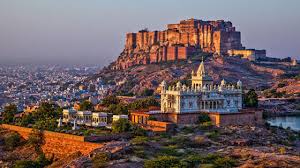
The sands of Rajasthan must have something special, the rugged countryside and hostile climate in some way have a role in toughening up Rajput mettle.
No other Indian state features a desert, the eastern most extension of the world’s largest arid region stops here. No- where else palaces are so elegant, a lot of them have been turned into star hotels though. Contacted a travel agent and planned a trip to Jodhpur .
The impressive Mehrangarh , its towers looming over the Blue City of Jodhpur offered a fine view . Around Mehrangarh’s base , the old city a clutter of blue cubes , extends to 10 km . It is the 16th century city wall. The name Blue city looks appropriate ! Most of the buildings here are painted blue. The city has a web of winding old streets.
They are the most mysterious walkways ever and beat your wit so much as to put you at places you have never imagined to be. Drift of aromas good and bad included fresh flowers, burning incense sticks and stopped up drains. Shops sell everything from trumpets and temple decorations to snuff and brocade.
Antiques are in plenty, the range of smoking hookas alone would leave you agape. The modern part of Jodhpur is just a fraction of a medieval city where high walled forts echo life connected with valor and legends born to be remembered by generations.
The city is a blend of history , art and cultural milestones impressing the visiting tourists. A popular hub,vibrant with life that would continue to be a source of making a living out of tourism for some .And a place of cultural passage for many . The western part of the city like Navchokiya, is more scenic . Rubble-strewn landscape seamlessly meeting limits of vision and relatively scanty crowd set you in a detachment from the mundane world.
We traveled through the Jodhpur city over a 4 day vacation covering the following:
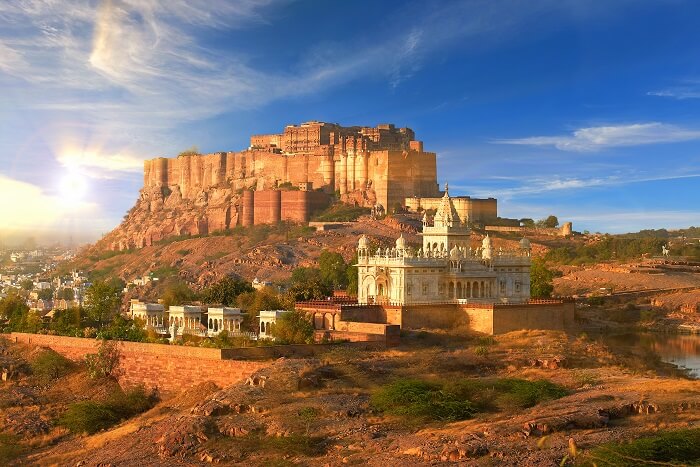
Mehrangarh
PC: travelogyindia
The construction materials were mined from the rock quarries close by. Administration of Mehrangarh is with the Royal family and the fort is rich in history. We entered the fort , spellbound by its sheer size and splendor. Very few trips can be as informative probing into the lives of Rajput kings.
Our guide spoke with authority and held us in rapt attention. From the Fort itself, the Blue City was clearly visible, a vista unparalleled and enchanting .Moving sea of tourists moved in and out. Plainly amazed at the architectural excellence echoed off every pillar and stone their cameras clicked non stop .
Mehrangarh Museum
PC indianholidaypvtltd
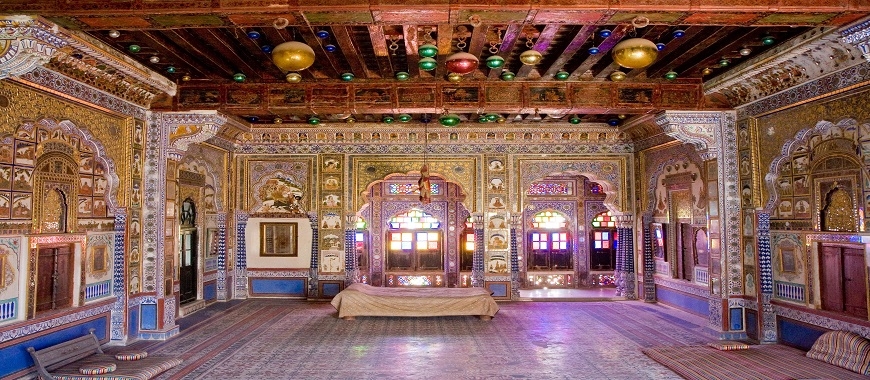
Moving on, I stopped at the Fort museum enclosed within the palace. The muddle of courtyards and halls had delicately carved stone work with stunning symmetry ending at sharp edges.The artwork was more like done in soft wood than in sandstone.
The exhibition centers at Srinagar Chowk (Anointment Courtyard) offered exquisite collection of ” Howdahs”(the seat on an elephant’s back ) and Jodhpur’s royal palanquin collection. The mode of transport was in tune with the status of people they carried. Those with blue blood lineage enjoyed luxury rides.
Mandore Gardens:
PC transindiatravels
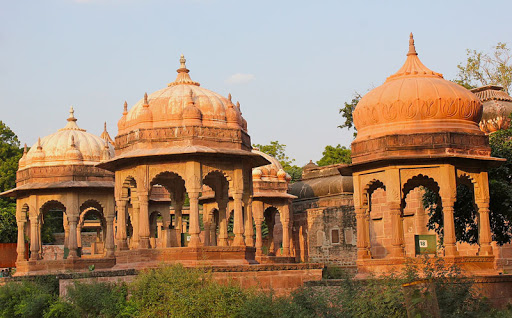
Mandore, located 10 km north was the capital of Marwar before its strategic importance shifted to Jodhpur. Rock terraces and sacred edifices added to the beauty of the garden where troops of langurs went monkeying around. The garden is a graceful combination of patches of green and temples were chiseled with intricate design.
Dark red monoliths of Jodhpur rulers were installed. They watch in silence, their glance held the posterity who stared back at the statues with awe. Sometimes words aimed at statues come with a hint of ridicule as it was a mixed crowd of tourists with diverse taste and humor. A rickshaw ride to the Mandore gardens from Jodhpur center takes around ₹ 300. The ornate temples carry statues of human and animals in congress. What is obscene could be interpreted as a valuable piece of art. Strange are the ways the human mind works and stranger are the benchmark for a fair evaluation. The garden features a museum too; it is unique in its own way so far Rajput cultural sides are in spotlight.
Guides explained heirlooms and images in a non stop litany, keeping the visitors engrossed. It is a habit, turned resident in their streak,they can recite it anytime anywhere blindfolded.Continuous rehearsals never fail them in their profession.
Waterways along parts of the garden have been turned into morass of synthetic reeds making them favorite haunt of water birds, glowing bee eaters and buzzing dragon flies.
Umaid Bhawan Palace
PC tajhotels.com
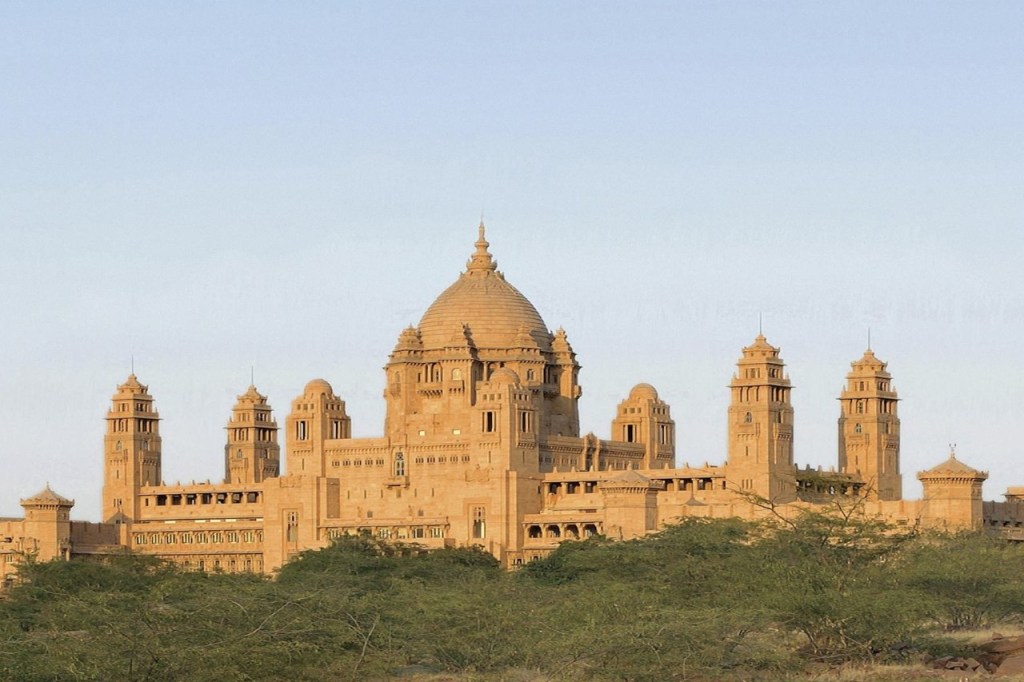
Umaid Bhawan palace had received a major coverage in my travel agents recommendation, so it is not to be missed. But the tourist’s access is restricted to only a part of the palace, a portion of it is the residence of the Royal family. A part has been converted into a hotel. We visited the palace and were bemused by its luxury.Fleet of vintage cars used by the Royal family was nice to watch. Machines from yesteryear’s stood in silence only to roar and take off at the turn of an ignition key.
Gaj Singh II resides in part of the hilltop palace, erected in 1929 for Maharaja Umaid Singh. Designed by the British architect Henry Lanchester, 3000 workers toiled for 15 years to finish the project. Project cost ran into ₹11 million. This magnificent edifice has more than 300 living rooms. A museum adjacent to the site looked interesting. It was an elucidating trip around a photo and artwork gallery.
What fascinated me most was an amazing collection of antique clocks. They have stopped breathing but continue to enchant the visitors with precision design details.
Rao Jodha Desert Rock Park:
PC inspirocks
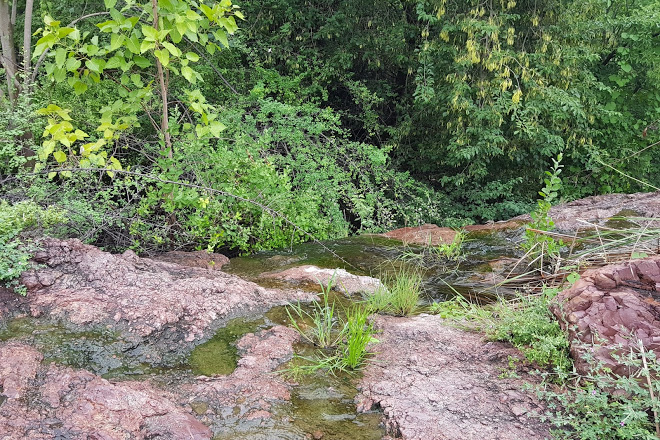
This 72 hectare open land, ideal for ecotourism and perched in the slope of Mehrangarh is a nice example of conservation of flora and fauna. Rich in biodiversity, the park carries numerous trails made by travelers and animals. Devkund Lake, a prime spot in the park is very popular, crowded with tourists for bird watching.
Besides migratory birds, a variety of reptiles and butterflies keep wildlife buffs occupied. We made it to the park when the sunlight was still soft. Our local guide was resourceful with good credentials. But we could not spot any animal. Otherwise, the park safari was exciting.
Absence of animal encounter was not frustrating at all as the guide kept us occupied with equally riveting eerie tales bordering on the supernatural. His stories were real and in desolate sands of Jodha Desert Rock as was claimed by him, you face strange incidents that do not offer an explanation.
Here stones whisper and winds throw up fire, air turns thick and uncanny feelings take over. To an atheist, the validity of such stories is open to question. But his tone of delivery at the fall of dusk,separated the spectral and the natural world by only a weak barrier. The region is a bed of 600 million years old volcanic rocks; it is all barren although not entirely void of life.
Jaswant Thada :
Overlooking a lake stands a marble tomb in tribute to Maharaja Jaswant Singh II. Just 1 km northeast of Mehrangarh, it is a showy masterpiece. A peaceful deviation from the bustling city rush that offered a fabulous glimpse of Rajput art. The monument was built back in 1899 featuring sculpted marble fretwork. The interior displays a row of oil on canvas. Portraits of Rathore Kings stare at you whatever angle you stand. You cannot escape their gaze.
This feeling mounts whenever you are alone in a one to one eye lock. The inside is immaculately conserved as you probe deeper into design, the magic turns more fascinating. It was unfolding slowly. The building is complete with antiquity and allows a breathtaking vista of the city through arched windows.
But something was amiss I could not figure out what it was. Then it popped in a wink. It was the portrait of Queens. There wasn’t a single female portrait. Was the route to Sati pyre easier than making it to the photo frame through a bureaucracy of male approvals?
Clock Tower
The famous Clock Tower had come a long way over a century since it was built. It is a unique location and talked about so often by pedestrians, cab drivers and two wheeler riders making it an important reference point in the city’s map.
Located close to the Sardar Market, the Clock Tower is a meeting place, its air a mixture of whiff, sound and glimpses of life pouring in and out of the market itself. On the way to clock tower, a line of sweet shops drew men and animals. While men paid, the cows were fed free as a token of charity.
Milk, the main ingredient can turn so tasty you won’t believe. Churned for hours in large cauldrons sitting on low fire frothy hot milk turns light saffron giving off sweetened rich flavor. Milk and sweets were sold on a frenetic pace. Sellers were happy with cash flow and buyers were happy as if they have just had ambrosia straight from heaven.
The market had gateways forming an arch, another signature design motif of Rajput architecture. From here, the twisty and broken roads radiate out in all directions reaching most of the landmarks of the Blue City. We moved west and reached a trading hub featuring separate sections for vegetables, spices, tobacco, utensils, wood , brass crafts and jewelry.
People young and old were busy in a potpourri of engagements. Some were too young, toddlers on an apprenticeship to the skills of walking. Some were way too old, wrinkles around eyebrows marking the number of years they have lived past. Strange flavor of water filtered tobacco smoke from hookkas filled the air. Long leisurely pull on the pipe and the facial wrinkles folded deeper into flesh !
Toorji Ka Jhalra
Located within a walking distance from the Clock Tower lies an ancient step well locally known as Baori or Jalra. Communal bathing formed a part of social custom as revealed by archaeological digs in many ancient civilizations.
Toorji Ka Jhalra however met irrigation needs here, fed by water aided by gravity along stone launders. Legend goes the ruler had decided to move the capital to higher altitude on hills fearing enemy attack. A curse fell warning famine, following shifting of capital. The need for a water reservoir to water the crops seemed necessary.
This architectural wonder had been a site of sheer neglect and used as a garbage disposal yard for years. Only recently it has received attention, renovated and turned into a tourist attraction. Toor ji ki Jalra is a visual treat today, we spent long hours in a cafe here gaping at the geometry. What a gifted mind can think of such a design and what hard toil can execute the physical part with meticulous wrap ! The coordination within the team must be perfect.
Fateh Pol
This super gate stands south-western side of Mehrangar Fort. It was erected by Maharaja Ajit Singh to celebrate victory over the Mughals. We approached Fateh Pol from Navchokiya side to avoid crowd. Once elephants stood guard at the gate.
They were the trusted giants who you cannot bribe to make an entry. Fateh Pol gate is impregnable, a reliable protection to residents inside. Here we had delicious paranthas and saabzi to sustain further travel for the day.
Chamundaji Temple
PC Google (tourmyindia)
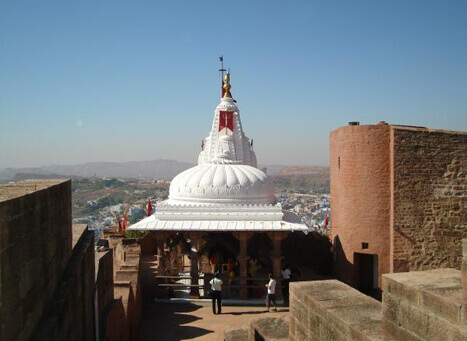
A temple of goddess Durga Maa enclosed Her idol, the image is in all wrath , here the feminine force of shakti is immensely revered . It becomes a little hard to accept the same cult promoting burning of sati with her dead man on pyre. May be there are higher truths in life that make physical pain look insignificant ! However, life is more complex and its equations often contradict with what is apparently logical.
The temple yard was thick with tourists, Indians and foreigners enchanted by sublime overtones. Participation in chants obsessed the enthusiastic foreign tourists and entrance to the temple had a male – female divide for darshan.
Jodhpur camp sites
PC Google
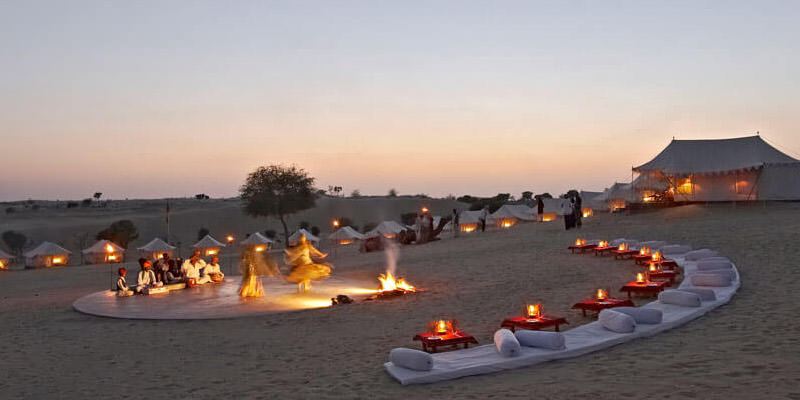
The best part was the last part and it was the popular Jodpur desert safari. We did it in Osian desert campsite, a night spent in a tent. It was a different kind of feeling in general and calling it just amazing won’t be a fair description.
Call it touching a congruence where exploring self finds an extension into wandering the vast ocean of barren nature. It is so vast that you and your pad are only a small micron of existence.
The evening camel ride in the dunes added to a new kind of feel. Had no previous experience of riding humped transporters fueled by super endurance. Unfortunately most of the dunes were gone, still whatever remained could hold you back for eternity.
Camps were complete with communal kitchen, toilet and a reception desk, tourist’s needs were answered well. Cabins and caravans were other staying options. Facilities included wifi connection too.
Sunset was spectacular and even stronger was the spell of folk music played under a starry night. Traditional musical instruments and the passion-driven high pitched tune were a source of bread in the backdrop of terrain, challenging and sterile.
Ambiance somewhat resembled a stage set from the Thuggee days except for the horrible curtain drop. It was just a thought in a flash. Nothing serious and nothing threatening. Folk singers performed late into night followed by candlelight sumptuous Rajasthani dinner .
 simplyroam