Vietnam ranks top among post covid travel destinations – know the top attractions

The conflict of political interests had spewed venom, but not enough of it to make this beautiful country accept defeat. Neither could Covid 19 pandemic. Vietnam with one of the least infected cases in the world and zero mortality till today when the write up is being created has started easing social restrictions from 23rd April. Many sites of attraction have opened or are about to reopen. There might be some entry restrictions allowing a fixed number of tourist footfalls per day to avoid any new surge of infections. This would be the new normal for every tourist destinations and is likely to stay for the next couple of years or so.

Non-essential services have also opened barring the discos and parlours. Although international flight operations are yet to resume, vacationers can plan in advance to visit this country after lifting of international travel restrictions.

A mountainous terrain sharing borders with China, Laos and Cambodia, Vietnam had its blueprint drawn up in heaven no doubt. Tourism in Vietnam saw record highs last year with a 20% rise in foreign tourists.

I was fortunate enough to get hooked on a 4 days tour package. From what I could gather tourism here is undergoing a massive transformation. What attracted me most is the beautiful fusion of Western offerings with authentic Asian aesthetics. This is what I have been looking for since long! Sand and sea continue to be huge crowd pullers. If you are looking for a luxe touch, recent developments will give you the feel.

Arrived at Noi Bai International airport, Hanoi and met the cab driver holding a sign with my name on it. The cab was fine but a little cramped without much luggage space to boot. He had packed the car with his chattels and drove me to the hotel. 

Day 1:
 

P.C. hanoifreelocaltours

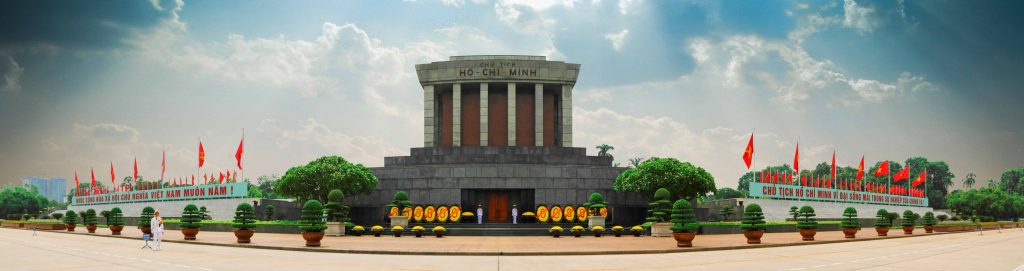
My first visit was to Ho Chi Minh Complex, a place of social gathering. Vietnamese people pay respect to Uncle Ho, the founder of the Vietnamese communist party. It’s almost a pilgrimage attended with fervor. The complex is captivating with prim garden, memorials, pagodas and their elegance making a lasting impression on the mind.

The house where he stayed is a typical traditional Viet living unit raised on stilts; a simple structure reflecting modest lifestyle. This house has a garden and a small tidy pool where a koi family swims in grace. In the complex stands the one pillar pagoda, in the centre of a lotus pond.

The structure, the quintessentially sacred entity in the country is symbolic of the lotus flower. The sanctum inside the pagoda is dedicated to Vietnamese Buddhist goddess Quan Ann. She has an image built inside a tiny temple. Leafing through guidebook I was reassuring if I was missing any spot. A monk was studying me from a small distance and came closer, asked my nationality in fluent English.

A conversation started, he took to Monkhood at 11. A pack of Mevius he carried apparently did not matter with the potentially delicate issue of smoking among religious people. I was about to ask but checked my curiosity I may be invading privacy. We walked and crossed the complex fringes; I admitted how amazing his country was. Nothing compared to what it used to be, was his reaction. 

 Pain in his voice indicated wound in the heart. The war had left a legacy of damage on crop, infrastructure and life. The road to recovery seems long but not endless. Viets have iron grit, they have proved it and they will prove again! He lit a Mevius cigarette, puffed a long drag and bade goodbye. The man was lost in the crowd. 

Visiting time: All weekdays except Monday and Friday

Tuesday, Wednesday and Thursday: 7.30 AM- 10.30 AM

Saturdays, Sundays and Holidays: 7.30 AM-11.00 AM

Winter Season time (from 1st Nov-31st March of the following year): 8 AM- 11 AM

Fares:

Ho Chi Minh Complex: Free

Ho Chi Minh Museum: 40.00 VND

Ho Chi Minh’s House: 40.000 VND/adult

Dress Code: sleeveless shirts, tank tops, shorts, miniskirts not allowed.

Camera, mobile phones and video recording not permitted. Children below 3 years are not allowed.

The Temple of Literature:

P.C. culturetrip.com

My next stop, the Temple of Literature. My guidebook was the only trustworthy companion, didn’t go experimenting for a hired guide. Things can go tricky. People pose for photographs and demand money.  In Coliseum in Rome, I have heard, dummy gladiators pose for photographs, they look amusing. You never know if there is a string in between at the other end lies a motive for money extortion. Any discord may invite a fight with the gladiator and that is very real. Quick conversion of amusement into threat takes you by surprise!

Built in 1070, it was a recognized seat of learning and one of the most appealing spots in the country. The building gets a clean up on a regular basis and much of the knowledge shared with students was on the premise of Confucian philosophy. Perhaps proximity to the Chinese border in the north could be an explanation.

Architecture belonged to traditional Viet School, its patios, galleries and causeways were used by the nobility. At the outset the doors were opened only to aristocrats’, later merit took over class. The Temple of Literature is set in a pristine stretch of turf with rows of trees and peppered with applause in travel magazines.  The trees are very old and offered relaxed shade to students. 

Opening hours:

All days of the week except Saturday

From April-October (summer): 07:30- 17:30

From October – April (winter): 08:00 – 17:00

Entrance fee as on 2017:

Adults nearly $ US 1.3/head

Students: $ 0.7/head (student ID required)

Children below 15 years: Free

Dress Code: Sober and casual; no short skirts, pants or tank tops

The Museum of Ethnology:
P.C. Holidify.com

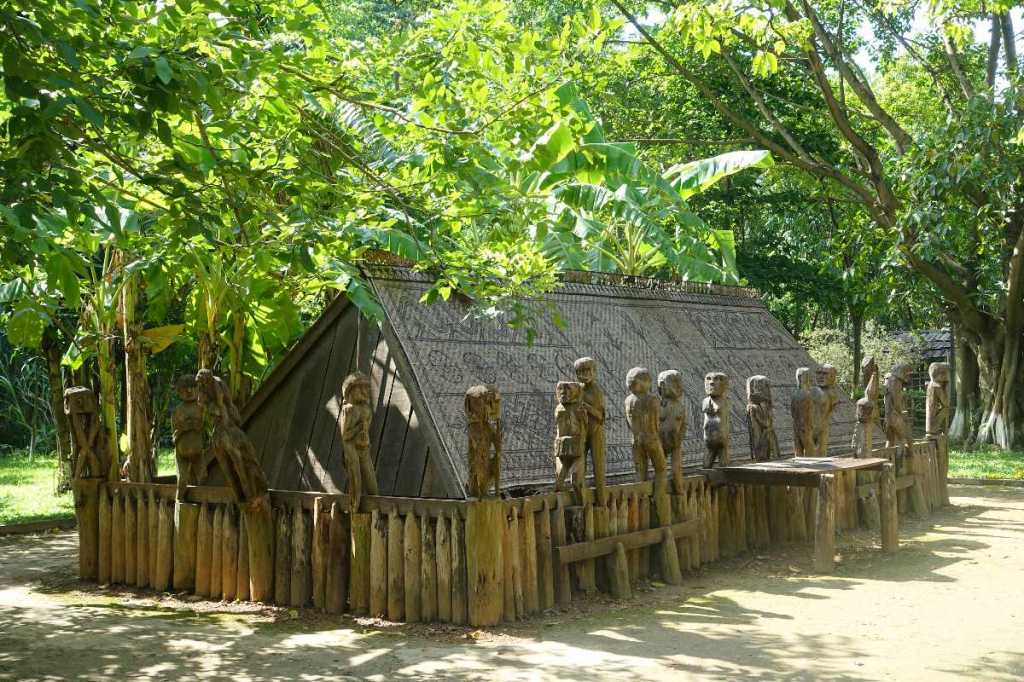
My next drop-in was to the Museum of Ethnology. It is a wonderful journey into the culture and lifestyle of ethnic tribes of Vietnam. A potent canvas in color and a revelation of untouched areas of civilization left me spellbound. Exhibits ranged from stuff of everyday use to tiny models of dwelling houses reflecting a sense of aesthetics among different ethnic tribes.

It included an auditorium, a library and a research centre, all of them focused on a crucible of cultural blend in regional diversities. The museum showcased around 15000 artifacts including photographs and audiotapes. It supplied an effective and interactive link with the museum visitors. The display boards were in English and French. In the evening I was scheduled for a Cyclo ride in Hanoi. You experience the traffic and the fun of it as you hit the roads. 

 A tight knot inside me was building up in the first few minutes of ride and it rang a bell. Almost the same feeling that I had in a ‘giant wheel ride’ back home in a neighborhood carnival! At least that was what I recall. That was Kolkata and this is Hanoi. Kolkata feelings chased me to Hanoi. After some bargaining we settled at a price, the Cyclo driver looked very clever. A glint in his eyes assured an exciting jaunt. But an artful smile somehow betrayed a vulpine craft I needed to guard.

 Fate has made him learn from life, bitter lessons in his struggle for survival. Rush hours in Hanoi saw stifling heat going up a several notches. Unpleasant experiences may come in between you and the joy of travelling. Overcharging for rides, sale of street food at a price like highway robbery is not uncommon. It would be unwise to agree to prices quoting numbers alone. The mention of currency is important. Don’t be surprised if you hear him say “I have asked my price in USD”. And you have been figuring out your budget in Viet Dong. (1USD = 23000 Dong approx) Just think of the enormity of rip off!

You feel so obviously cheated and barely can ever conceive that the ploy could be so blunt and yet forceful. The crook shouts out, giving a sticky slant to the event, forcing you to agree to spare a bad scene. Not knowing the language is a handicap!

It was a strange paradox that I felt vulnerable and yet cool on the cyclo. It’s usually the driver who is in front of you in a ride. On a cyclo the scene is different; he operates from the rear as if putting you up as a shield. I felt open to traffic rushing in! Hardly any road rules exist here in busy streets, scooters run in all directions without any rhyme and reason. The moment you fear a collision the cyclo driver saves you from disaster.

His control over the ride is par excellence, steering the cyclo smooth and easy winding through a rush, mad and all screwed up. Yet no road accidents happen my salams to his skill! Vehicles shot at us and we dribbled past, soon I was quite enjoying the ride. The Old quarter of Hanoi is amazing and dotted with restaurants, colonial buildings, parks, schools and market places.

The driver was bubbling with energy and would stop at places educating me on the history of Vietnam, edifices and memorials. A little English and the rest in sign language worked for us. He knew the Old Quarters like the back of his hand. 

Opening Hours:

Daily from 08:30-17:30. Closed on Mondays.

Hoan Kiem Lake and Water puppet show
P.C. Vietnamtravelguide

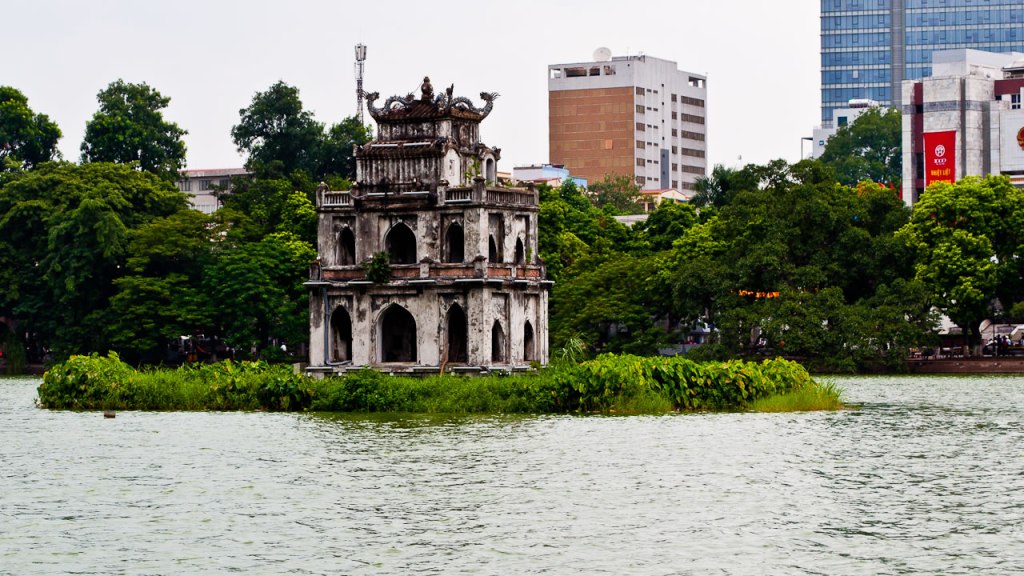
Centrally located this lake is a cynosure vibrant with life. When I reached, the sky had turned red. Tourists at waterfront bars were busy with sundowners. The lake shelters soft-shelled turtles. They are revered here and just about lauded to a status of celestial entities. The water was a shimmering gold in the dying rays of the sun disguising its actual color. A dark green sheet with ripples lapped the banks, it was a treat!

Thang Long Water Puppet Theater is a much sought after tourist haunt. It is a rich Vietnamese folk art of the Red River Delta and connected with rice farming and harvest. The sheen of light and fireworks added more flux to the puppet dance. Bought tickets and occupied seats, wished the gap between rows were wider, not enough leg space to relish a relaxed evening.

Puppets looked amusing in color and action. They danced to folk music, the puppet masters hid behind curtain maneuvering the rope- tied puppets with surprising adroit. One end of the rope had the puppets and the other end tied to poles worked from behind the curtain. Cute little dancers were made from some light wood else they would sink like dead weight. 

Day 2: Hanoi – Ha long overnight cruise:
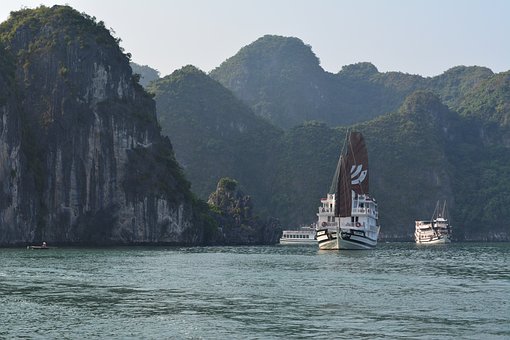
Itinerary included a trip to Halong Bay on an AC minivan. On the Bay, the cruise was on ship Athena. We reached Ha Long in 3 hours. The view was breathtaking. Rock formations broke water and the cruise was in the surreal waterscape. The horizon was a thin line between the sky and placid water.  Athena was a dream ship lithe and streamlined!

I had booked an Executive suite with balcony on the first deck. The suite was well furnished; had a wonderful time spending 4 hours on the Bay. The sail was breeze along water corridors in between limestone karsts. Junks and sampans moved past us, they must be sailing to preset appointments. The ambiance was too good to be true exalted by scrumptious Viet cuisine served on board. Much of it was seafood caught fresh from the Bay.

Small bamboo boats were dwarfed by Athena. Boatmen alternated use of limbs working the oars. Sometimes it was both the hands and sometimes they rowed with legs alone relieving shoulders .Must be hell of an effort, the expressionless faces did not show any fatigue though. Bay eagles occasionally dived for a living.

It is not easy in the sky, not easy on the boat either. Struggle for existence is everywhere and from the privileged luxury suite I felt a little guilty. The cruise continued to the second day and had an amazing stopover. Before that it was a pulsating night with booze and band, DJ’s and dance on the floor whoopee. 

Rounds of onboard games made the holidaymakers high and happy. The late night ball ended in a hearty dinner and some quality sleep on a snug king size bed. Sung Sot cave in Bo Hon Island is a UNESCO World Heritage Site. The ship docked on the pier, we set foot on the rock. Way to the cave was lined with trees the atmosphere was serene with an exotic appeal.

It was way cooler inside the cave; stalactites and stalagmites fell and rose responding to dictates of the geological clock. Hundreds of neons lit them up in an alien luster. Cruise ship Athena cut across emerald water further east towards Bai Tu Long Bay. Here tiny islands are scattered and the beaches are lonely and tranquil. The rush of tourism is low and the impact of commercialization negligible. The islands are thick with rainforests and the habitat remote and wild. 

Day 4: Cu Chi Tunnel:

Arrived Ho Chi Minh City last night. Cu Chi Tunnel is rich in history marred with war casualties and gun smoke. The incredible web of tunnels has a significance being witness to the war. As much as the infamous Tet offensive being a turning point for the country. Guerrillas of Vietcong fighting an uphill battle against South Vietnamese troops were episodes of epic scale.

Now, the US and Alliance forces stepping in, the war took a more violent form. Hideous throwback inside Cu Chi was in the vibe. Conversation between tourists fell to whispers who were introduced to brief video snippets of painstaking tunnel construction. A lot of blood and sweat had been shed, a ceasefire was certainly imperative.

An underground bastion for arsenal, supplies and infirmary, it was a one-stop cover for Vietcong troops. Endurance and launching counteroffensive was the key to staying alive. A quaint river close to the tunnel had ducks and water buffaloes in peaceful coexistence. Neither the serene rice fields echo the shriek of carnage nor do lush woods remind us of defoliants used to devastate the land. The tunnel trip ended with tea and cassava, the frugal diet soldiers ate. Retired to Saigon hotel and more trips waited post lunch.

Independence Palace:
P.C.Nickswandrings.com

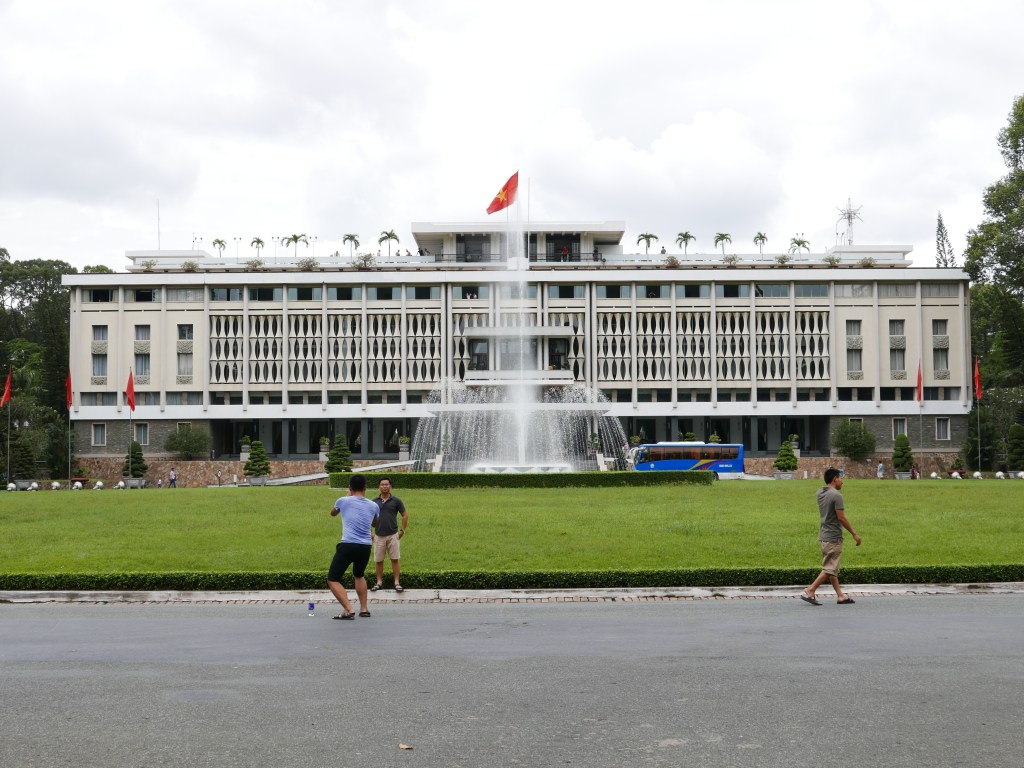
The Reunification Palace built as a renovation on the site of the erstwhile Norodom Palace, the imposing building is a grand affair; its design is the brainchild of architect Ngo Viet Thu. During the war, the president of South Vietnam resided and functioned from here. Its historical significance marking the end of war had been theatrical when a North Vietnamese army tank crashed through its gate.

It is hot and humid out here making beads of perspiration on the eyebrow. The sprawling lawn and fountain went well with the overall grandeur. The crowd was cosmopolitan, tourists and locals were in a tension-free slow motion footslogs approaching the palace interior. The interior featured luxury with decorative. Separate rooms for conference, office work, living, dining and corridors were all spick and span. Visitors were flocked around mementos and exquisite furnishings with a European influence.

 Notre Dame Cathedral:
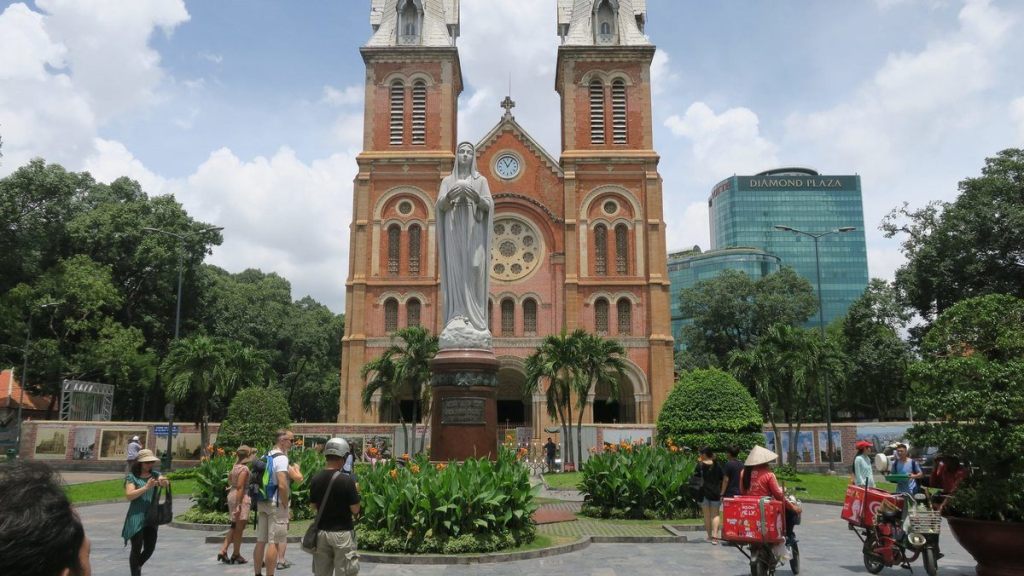
 P.C. atlasobscura.com

Trip to Notre Dame Cathedral was preceded by an incident. Honesty in crowd is rare but not unlikely depending upon chance factor. My lost wallet was handed over to me by a local. Didn’t realize when it slipped out, he stared at me and smiled. A silent communication bridged our thoughts. He looked happy having helped a stranger and the man found a room of respect inside me. 

The Cathedral is a goliath edifice ringing somber tone of faith and its twin spires stood high in the sky. The foundation was strong enough to support ten times the weight of the cathedral itself. No wonder it had lived through the ravages of war. But much of the tiles, originally French, could not escape damage.

They were later replaced by products of Saigon kilns. As a consequence of the French subjugation of the region, the Roman Catholic Church had set up a religious base for the French people here. 

In 1962, Pope John XXIII blessed the Saigon chief Cathedral and the status of basilica was bestowed. We have the Saigon Notre Dame Cathedral Basilica since then. Arches and glass panes are an epitome of French art they shot back the evening sun in a sublime tapestry of color.

The Central Post Office:

This imposing building is the largest post office in South East Asia close to Notredame Cathedral. A reminiscent of French colonialism, the post office is an example of careful conservation. Though very much oriental in essence in few pockets in Saigon (Ho Chi Minh City), the echo of French occupation is strongly felt. The building’s arched windows with wooden shutters bore a sharp contrast with Oriental upward-curving roofs.

The post office looked like a huge cathedral and a big portrait of Ho Chi Minh hung at the far end of the building. Glazed flooring, panels and sleek looking counters and benches amazingly stood in a great visual balance with medieval arched ceilings. The interior captured a bygone era featuring old phone booths, letter writing desks and glue pots.

The atmosphere had an old European charm only if not the large portrait had been a grim reminder that I was at the heart of a strife-torn nation. The sun had touched the rim of the world soon dusk will be all-pervasive. The temperature started to wane as I made headway towards Saigon hotel.

Mekong Delta cruise:
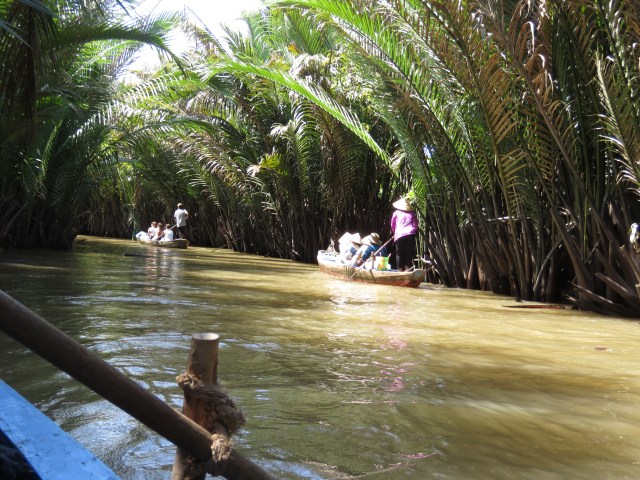
My last day of stay in Vietnam was kind of a hurry exploring the Mekong Delta. This is a big river with tributaries emptying into the South China Sea.

Started at 6.30 morning, a bus ride from hotel reached us to Delta port of My Tho. To call Vietnam tour super without doing Mekong cruise is underselling its tourism potential. The small fuel-powered boat cut across smoky water. After a while, we got somewhat used to the chug of the engine. Herons flew low over us letting out squawks.
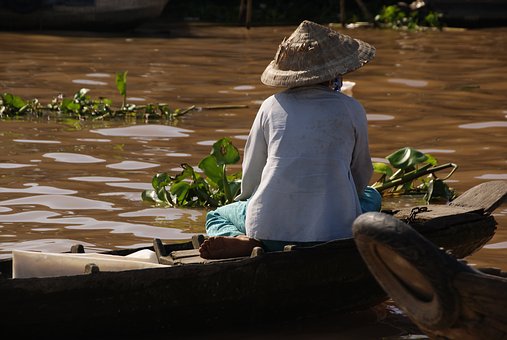
We left My Tho far behind and moved into a more scenic landscape. Viet rustic setting is splendid, vast stretch of paddy fields seemed never ending. Houses along banks were built on stilts giving them an iconic look. A very familiar construction identity in Southeast Asia but why on stilts, there aren’t any threatening wildlife in this region except Mekong crocodiles. Flooding could be a reason. River water overflows banks in monsoon causing havoc. 

We touched the mooring at Kimmy chocolate factory supposed to be the largest in South Vietnam. Chocolates are handmade and delicious, a little bitter though and capable of matching strength with the branded ones.

We sailed on low tide keeping close to the left bank. Biodiversity is amazing with a large number of animal species. Vietnam tigers are up north and on a steady march towards extinction. Low water level exposes more of the bank leaving rotten fruits, plants and dead matter that may have been washed ashore. It becomes a feeding ground for scavengers. We skimmed the bushes, a fishing cat came in view. 

Next, we came up to a fishing village. Houses were erected on stilts! Nets were stretched taught, fastened to poles and hum of flies went on and off in a rhythm. Children flocked around tourists with expectation in their eyes. Unfortunately, I had nothing to share except smiles and a brief photo session. They weren’t a bit camera shy. 

The heat was slowly rising it was noon. We were treated to Viet lunch rounded up with fruit and honey. Lunch done we were sailing towards Bang Lang stork sanctuary. This is a peaceful refuge for birds located in Thoi Bin hamlet. Our boat hit the jetty and from here we were to go walking.
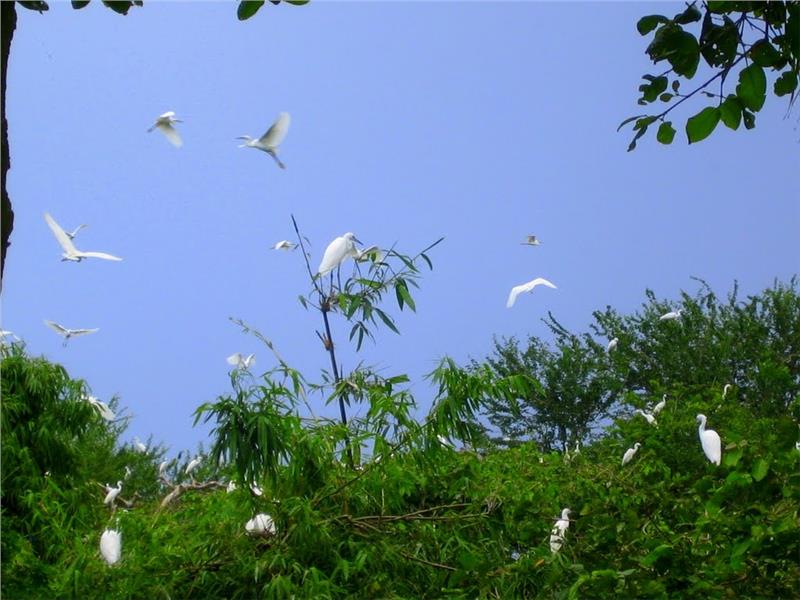
P.C. Alotrip

We crossed a wooden bridge and went through orchards; trees were laden with ripe fruits. Felt like scrumping a few if not the guide had warned us against grove centipedes. These insects must be very repulsive although fried versions in Saigon street food kiosks didn’t look bad.  Twenty species of Storks and we could see only a few of different sizes. Not only the storks, herons, egrets, ibises and flamingos had made a large and noisy rookery. 

Before sunset, more storks were foraging the marsh for evening grub. Shutters clicked and treasured images captured. This sanctuary is a natural development in the early 90s. More birds started inhabiting getting signals of security and assurance of food.  Storks find a position among locals. The birds are a symbol of hard work and integrity. My thought chain was broken our guide had asked us to call it a day; walked backed to the jetty carrying wonderful memories and heart full of love. 

Why not opt for a Nakation next outing

Nakation aka clothing-optional vacation (some may call it Nacation) is a hot topic in the global tourism circuit. Tourists, both males and females, crowding beaches and resorts are enjoying ditching the clothing. Cruises too are boarded by people who love stripping themselves to a rising crescendo of delight. It is not that they have stripped themselves of the fundamental human modesty. Neither have they scraped themselves of the basic decorum of civilization.

The fear of public embarrassment is overshadowed by intense bliss bringing nature closer once the clothes are removed. Simply put, the need to wear clothes in these nude vacation spots appears meaningless. Attire is undesirable confinement that binds your freedom to shackles.  A free-spirited philosophy here you don’t equate nudity with sex fired by lust leading to promiscuity with basic instincts gone awry.

Back to nature:

The proverbial back to nature club is right here in the Nude vacation destinations. Clothes advocated by a refined society are essentially seen as a barrier between a human body and nature. All the boons and pleasures loaded in the surroundings are denied so long we are in clothes. This feeling is quite strong and viral among a class of people who unanimously agree upon having nude vacation destinations.

Does Nakation have a future?

Well, the travel pundits say ‘ absolutely ‘.  The travel destination nudity is fast picking up steam. Within a few years, it will run into a billion-dollar industry. The state of Florida is already seeing a swell nude tourist crowd. Beaches here are practically crawling with nude enthusiasts; it is the new name for dollar machine.

Back in 2003, estimates published by Forbes magazine on nude recreation is big news to reckon. It will bloom into a USD 400 million industry. Numbers reported by the State Tourism Department disclose a huge revenue gain for Florida.

Last year, the Sunshine State of Florida had an infusion of USD 7.4 billion from leisure inspired by stark naked holidaymakers going bananas. But keep in mind it is a controlled fit of ecstasy where basic moral codes are not taken over by turpitude.

Millennials like it too

Media relations officer for the American Association for Nude Recreation (AANR) Mary Jane Kolassa comes up with insightful revelations on nude vacation. A random sampling puts most of the nude beach vacationers in the age group of 45 and onwards. However, she holds that the mix is on a constant move, mature adults are now accompanied by millennials and Gen Xers.

Pure whites, Hispanics and Black Americans go hand in hand in a delirium of heightened exultation from nude beach experience. Just as going off the grid brings us closer to digital detoxification, shunning the clothes removes the uneasiness of banishment into trappings of fabric.

A great leveler:

It breaks the barrier of differentiation based on the price of the suit you are wearing. It makes the boundary line of classification between the aristocrats and proletarians disappear. Without the quality of dress wound around you, a celebrity sun- tanning beside you is no bigger than what you are! The concept sells like hot cake and looks like a significant factor behind the popularity of nude vacation destinations.

Nude vacation, breaking the traditional concept:

Nude vacation beaches are not a novel concept. They have been in the tourism scene for some time. Nude resorts have been a comparatively new fad. But innovations in nude tourism have travelled pretty much now covering sea cruises as well. Special mention goes to Castaway Travels having headquarters in Texas. They rent out cruises where passengers would like it all dressed up or completely nude is just a matter of choice.

According to estimates projected by Donna Daniels, the joint owner of Castaway travels this year’s sale would book 7500 passengers on three chartered voyages conducted by Royal Caribbean Cruises and Celebrity. To spice up nude cruises, fun and entertainment are programmed in. They include adult comedy shows, costume nights and body painting.

What is driving Nakation?

Most of us have a stereotyped life set in a formal straight jacket. Regular chores of waking up, feeding, caring for family, commitments, going to the office and coming back seem monotonous . There is another side to it, and that’s the rebel inside.

It craves for more liberty and self-expression, it is his instinct that has made man break free and enjoy more freedom. This is sort of mapped into genes, some may want it wild and some moderate and for some it is dormant.

Suppressed longings are nothing unusual; it looks around for social approval. A nude vacation trip feeds this desire. The adrenaline rush from Nakation perhaps gives the same excitement as from snorkeling, mountain trekking and nature camping.
A psychological block is but natural when it comes to undressing in public, but when you are a part of a large nude group and merriment things may turn therapeutic. It kind of help removing the block and Nakations offer the right platform.

In Nakation resorts, exhibiting your nude self will not invite any legal litigation. Nor is the act of viewing your co- tourists exhibiting their naked bodies is banned by law. This triggers encouragement to release the exhibitionist self within us bringing in gratification. If you have a chiseled body by God’s grace, it will be a cherry on the cake.

Besides, nude vacation resorts with its liberal tone are believed to boost self-confidence. With a setting charged with excitement, these gardens of Eden promise, subscribe to their immense marketability. It is all very delicate and refined and yet so primitive and beautiful that it strikes a chord deep inside!

Nakations arouse our inquisitiveness that is fundamental to human nature. At the same time, it balances the relationship between the open exhibit of nudity and satiating curiosity. This wouldn’t have been possible in a regular and normal holiday camp.

Development of the trend:

The desire to display one’s nude self is a 16th Century concept. It has come a long way and what we have now are Nakations with featured amenities. These holiday resorts are completely equipped with facilities to take on growing visitors’ footfalls. Restructuring tourism ideas have taken Nakations far beyond concepts of tanning nude on beaches. Nude tourism has been extended to hiking, canoeing, skinny dipping and along more exciting avenues.

Mass desire to go off the grind stripping down to bare skin is where the secrets lie. Moreover, the class demarcation between blue and white-collar tourists will disappear once there are no collars at all to make a social divide. This concept of equality has a powerful mass appeal that Nakations are selling. It somehow brings out your inner mettle, your identity mark. Not the classy outward show of affluence and superiority made-up by the expensive clothing.

For Nakations, it would be an incomplete anecdote without a mention of Nick and Lins, a Belgian couple in mid-30s. Co-founders of Naked Wanderings they have made a recent global trip “as naked as possible”! Blogging all the way their experiences they were the brand ambassadors of naked tourism, glorifying the cause and the brainwave. Nakation brings a shower of benedictions’. You travel light, you feel free, good for your spirit and great for your skin!

Physically irresistible attraction:

Once you undo your clothes, you can feel the kiss of breeze all over. Putting no clothes on feels comfortable than captivity inside a shirt and if it’s soaked in sweat it’s the worst thing around. Removal of the dress gives your skin a space to breathe and relish every moment of exposure to air, sunlight and a starry night.

Nakation resorts eliminate stress. Initially, there may be inhibitions and embarrassments, but when you feel you are not alone, joy will overtake discomfiture. In fact, on the other way round if you are the only dressed tourist among champions of nudity you will feel being the odd man out.

Once you dispense with your clothes, shed your vanity and inhibitions you feel you belong deeper into mankind. Your essence is described by the stuff you are made of and not the clothes that may make you look like what you are not.

15 amazing Nakation experiences you can only have without your clothes on:

  1. Sauna and splash in a Finnish Nakation:

A modest sauna is very much a part of the Finnish culture. A fair degree of impartiality can be seen in the society where everyone is treated equal and this turns into a craze. A sauna bath is seen as a great populist public place where once stripped, the pedigree that differentiates people vanish.

Men and women irrespective of the age group are nude in a Finnish nakation, it is a lifetime experience. Here you enjoy every inch of your nude self dipped in warm and caressing water. For a change, you may leave your sauna and plunge into a Lake freezing cold. That done run back to the cozy sauna and spend carefree moments. Isn’t that wild and vehemently alluring.

2. Visit Austria’s Aqua Dome:

Austria’s Aqua Dome located in Tyrol region is a wellness retreat mirroring the excellent sauna culture of the nation. This is a super theme park both in terms of size and awesome services. The facility includes seven saunas packed with surprises unique to each of them. In addition, a ‘glacier room ‘ and a ‘salt pool’ that will keep you buoyant are equipped and designed with state of the art amenities.

You can relish all of it only if you join the fun naked. You will find other tourists from different social brackets and nationalities. One feature common to all of you is, everyone is nude and that way all are equal at least judged by free and frank body gestures. Initial hesitation will melt away and you start feeling normal and comfortable in the company of people looking so dignified in their birthday suits!

3. Magical nude moments in a Russian Banya:

Language may turn a barrier and a cause of puzzlement for foreigners visiting a traditional Russian bathhouse known as Banya. The sight of nude people huddled in a sauna cleansing each other under a shower is certainly amusing.

Many engaged in a spree hitting themselves with birch twigs is perplexing to outsiders. There is a beer session where the group drinks in a lounge. There isn’t any barrier though, you can also join the gang and drain the glass to your joy. The only thing you need is keep your dress in a closet and step in nude.

4. Dine at Bunyadi in London:

London’s Elephant and Castle is currently non-operative for financial reasons but soon hopes to reopen once the financial crisis is solved. The theme of this joint is being close to nature. It is a vegan dining experience where guests are all nude and the wait staffs are nude as well. Food served is paleo diet taken almost raw as was eaten by cave men. Elephant and Castle is a unique experience for sure.

5. Japanese Onsen

Japanese Onsen or hot springs form an important part of Jap culture where visitors remove their dress completely and enjoy the kiss of warm showers. Your clothing discarded you feel more interactive with nature. Hot springs do good to eliminate ache from your bones and muscles. Nudity removes reticence.

6. Jimjilbang in Korea:

Here is the idea is to get a wonderful exposure to Nakation in its entirety. Less emphasis is placed on nature’s interference with human entertainment bordering on nude rapture. Here you strip yourself and get into warm water for a bath.

In big and modern Korean cities, Jimjilbang comes with additional facilities. Barbers and restaurants, relaxation corners and movie houses come at a price. These are remarkable entertainment centers leveraged around the theme of nude tourism. You can spend the whole day here completely immersed in comfort.

7. Turkish Bath:

Turkish bathhouses are as famous as they originate from a tradition running back into centuries. In Turkey, taking a communal bath is a sort of ritual. Pleasant surprises exist. While you lie on the hot stone, attendants will scrub you clean. Remember while all this is being done, you are in a bare towel to guard your modesty.

Warm hot tea is served while you relax on a couch in the lounge. It is a wonderful feeling as you sense your tension melts away. It is as hassle-free as the way you got yourself rid of the clutch of your clothing.

8. Naturist resort in Australia:

Naturist resorts invite people in their birthday suits. They can be fairly top notch to average ones. You will find every service here; sauna, boozing lounge, cafeteria and all of them only with a difference. The guests are all stripped to their bare skin.

Some unique on-beach nakation experiences:

9. Samurai Beach, New South Wales, Australia:

The beach is amazingly pristine, wonderful and is quite famous for nude barbecues. Surfers, fishermen and beach buffs from all age groups are seen here. They are all in a jovial mood. Nudist clubs from the Newcastle visit the beach once every year for fun and gambol. They wear nothing except smiles on their faces and spark in their eyes. You can join them in the game the rule is you got to go naked

10. Zandvoort beach, The Netherlands:

In The Netherlands, nudity is encouraged and scope for nude entertainments is plenty. Zandvoort beach is quite famous in nudist circles and an annual New Year’s Day morning is celebrated for skinny dips. People roll in sand and surf in a mood of merriment and it is a treat to watch. Even more would be the excitement to join the crowd in the clean fun they have a ball in cold water.

11. Black’s Beach, Southern California, San Diego, US:

This beach is guarded by the Torrey Pines Cliffs and you got to access it along a half a mile downhill trek. The University of San Diego being close by, the beach is frequented by students in summer. It is a big and crazy summer  and you can spot beach enthusiasts lying completely naked. You can join in too no one will raise an eyebrow.

12. Sovinje, Island of Pasman, Croatia:

This is an appropriate beach in Croatia to realize your wildest fantasies in a nude holiday. Restaurants, malls and cafes are in plenty set in a line along the moorings. There is no dearth of greenery, pine trees stand in a row throwing shade on sand. Sea water is clean and clear inspiring swimming, snorkeling and paddling.

13. Wreck Beach, Vancouver, Canada:

This Canadian beach is a fabulous nudist beach located at the bottom of a long and scarped pathway. The trail originates from the campus of University of British Columbia. It is easily accessible and the oldest nude beach where you are not prosecuted for not putting on clothes. It is legally approved to go naked so long you keep your humor within limits.

14. Parque Nacional Natural Tayrona, Columbia:

This nude beach is made famous by mid thirty nude couple Nick and Lins. These travel bloggers of ‘ Naked Wanderings ‘ fame had made a worldwide sensation. Access to this beach has two alternatives. Either you row your boat for long hours to reach it or choose to trek along dense jungles.

15. Point Addis, Victoria, Australia:

This Aussie nude beach is vibrant with activities and fun like Frisbee, yoga, sunbathing and swimming. From Melbourne, you take the Great Ocean Road to reach this beach. It is simply picturesque all along the drive with spectacular cliffs hanging over ocean water. The crowd is an amalgam of all age groups and going nude on the sand and surf isn’t a big deal.

Dos and don’ts on a nakation:

Nakation hotspots are great for those seeking a completely carefree clothing-optional vacation. But these recreation spots come with specific rules and etiquettes which may seem more than a residential school. Here’s a short guide on what you are expected to do and not to do while on a nakation:

  1. Ensure the destination is clothing-optional:

Hearsay information or reading somewhere about a beach/resort being clothing-optional may not really mean so. Do enough research and get information from authentic sources that the destination is meant for nakation. If you are unsure, keep your clothes on. Public nudity is condemned in many places. You may be slapped with a hefty fine.

2. Look for Naturist Resorts:

These are ideal for those looking for entirely clothing-free nakations. It can be family-friendly or adult-only resorts. You are likely to get many options suiting your budget.

3. Never ever stare:

Viewing and staring are two different approaches. You should never stare, point or giggle on somebody while on a nude beach or resort. There is nothing wrong to look at your fellow nude vacationers. You may need to interact and greet each other. All these are common etiquettes but there should be nothing beyond this

4. Do not expect chiseled bodies:

Well, if you expect chiseled models or handsome blokes around, you may be disappointed. Keep your expectations realistic. Nude-patrons come in various shapes, sizes and colors. You are likely to see all normal humans enjoying nakation.

5. Avoid taking pics:

Never take pics of anybody without their consent. This is applicable to all tourism destinations. Check whether photography is allowed in nude beaches or not. After all, clicking a naked subject is always debatable. Even if you don’t mind getting yourself clicked naked, explore where it can end up. It may create awkward moments. Never forget the possible harms that can arise from social media sharing.

6. Avoid sexual activity and public display of affection:

If you are enjoying nakation with your partner, maintain your dignity in public display of affection. Too much of it can offend others and spoil the ambience. Such activities have led to the closure of many nakation spots in the past.  For a more intimate experience, you can opt for private beaches and resorts.

7. Keep your clothing on while visiting certain public areas:

While nudism is permissible on the beach, it may not be acceptable in specific public spaces like cafes, eateries and parking lots. Be in your clothing when visiting these places.

8. Keep your body protected from sunburns:

Too much exposure to the sun can be damaging for your body especially the sensitive areas. Those sensitive areas normally covered by swimsuits can be badly damaged. Cover those areas with a thick layer of sunscreen. You can use a towel for extra protection.

Essentials to pack for Nakation:

  • Soft and comfortable towel long enough to cover your body
  • Bathing suit
  • Enough stock of sunscreen
  • Hat
  • Jumper
  • Sarong
  • Light jewelry
  • A pair of goggles
  • A pair of flip-flops
  • Insect repellant
  • Cooling gels
  • Enough stock of hydrating lotion
  • Cooler box to carry water and beverages
  • Condoms and sex-items

Nakations are getting popular but may not be to everybody’s likings. One should be open-minded free from inhibitions to enjoy this naturist vacation. Even if they seem exciting to you, check with yourself whether you will be comfortable with it. Trying something new adds spice to your life. At the same time, you also need to be prepared so as not to get a cultural shock. Travel is evolving in new forms, why not have a taste of a different kind?

The thrilling trek to Borra Caves, Araku

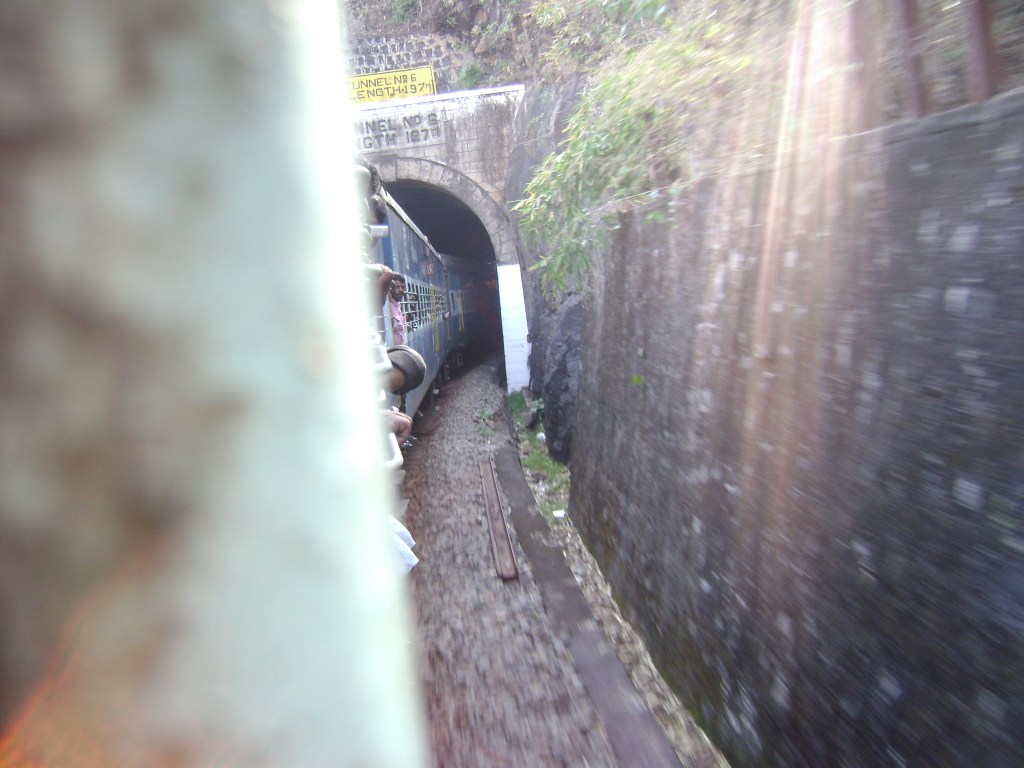
The mouth of Borra Caves was as awe-inspiring as was the element of dismay following events from entry to exit. The size of the cave is a feature to reckon with, being the largest of its kind in the subcontinent! One route is from Vizag. Kirandul express, starts early morning and reaches Araku around noon. Borra caves come half an hour before. The trip by Kirandul Express was zero cool, the train crashing through countless tunnels of the Valley in the Eastern Ghat mountain range.


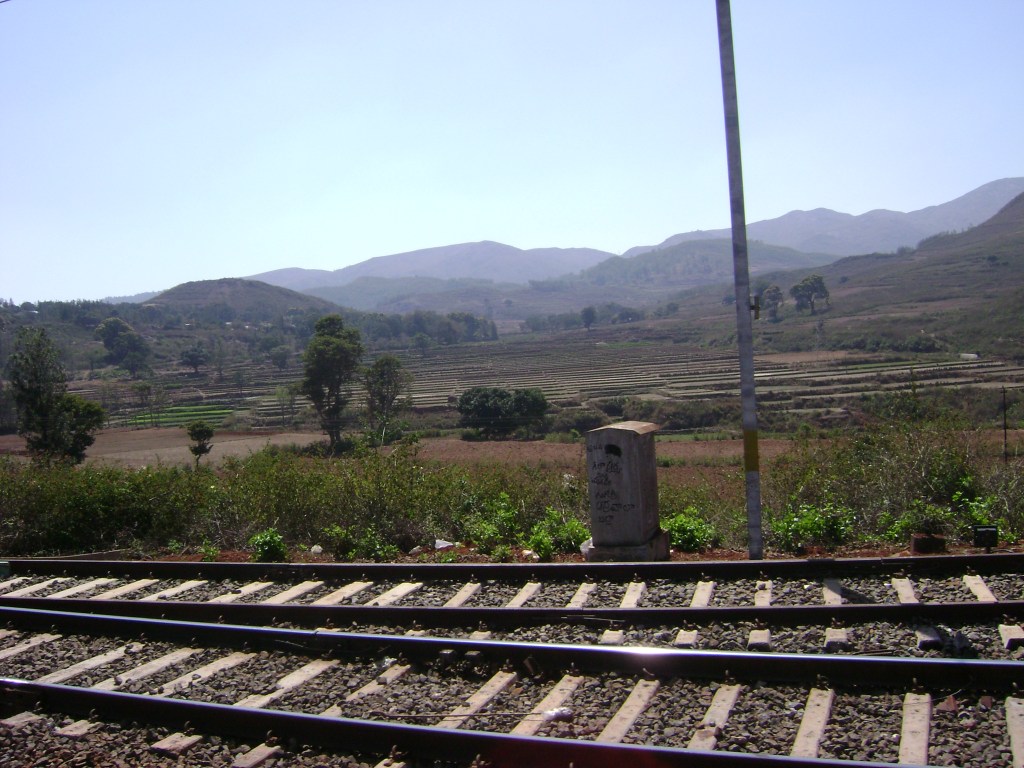
One moment we were in darkness and the next surrounded by lush meadows, spectacular valleys and distant hills. It was in March with heady vibes afloat in the air. Our mood soared riding an amazing spring carrying fragrance of nature.  As expected, the train was packed, perhaps the imminent festival of Holi held an added charm. 

Delving into the Borra Caves:

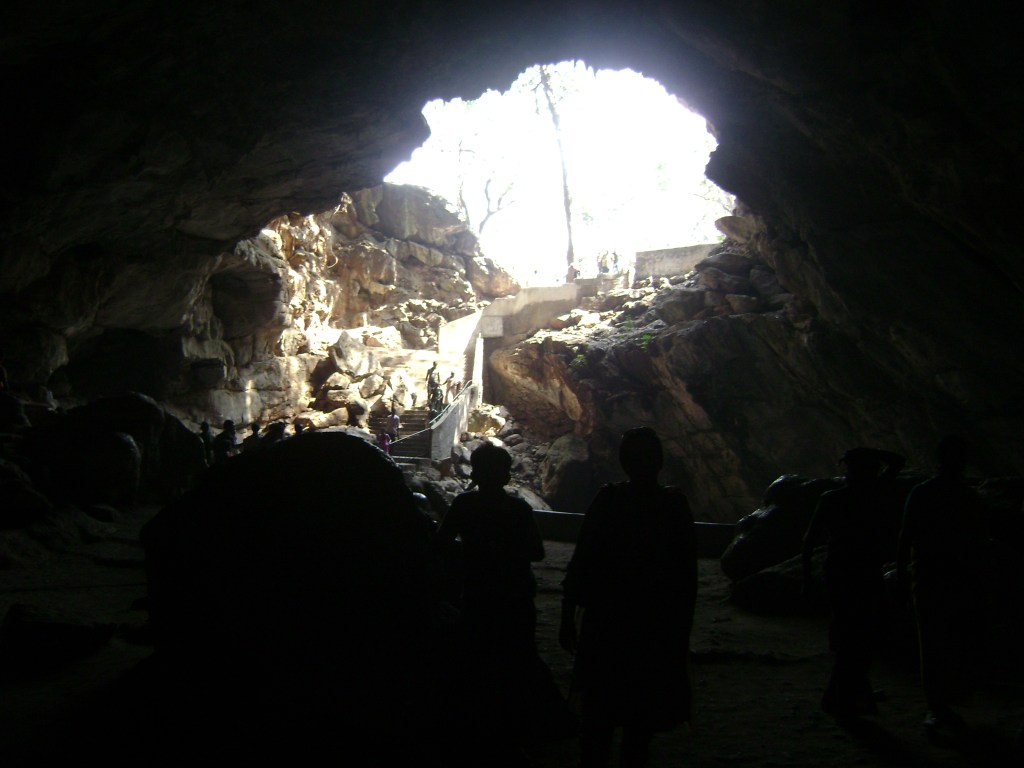
Close by the cave flew a spinning creek with an awesome view.  Borra Caves, locally known as Borra Guhalu, comes from two words, Borra meaning ‘ Hole’ in Odiya and Guhalu stands for ‘cave’ in Telugu. Located in Vishakhapatnam district of Andhra Pradesh close to Odisha border, the region brings in a wonderful cultural fusion pronounced in language, culinary influence and demography. The deeper we went inside, the weaker the beam of light from mouth grew.

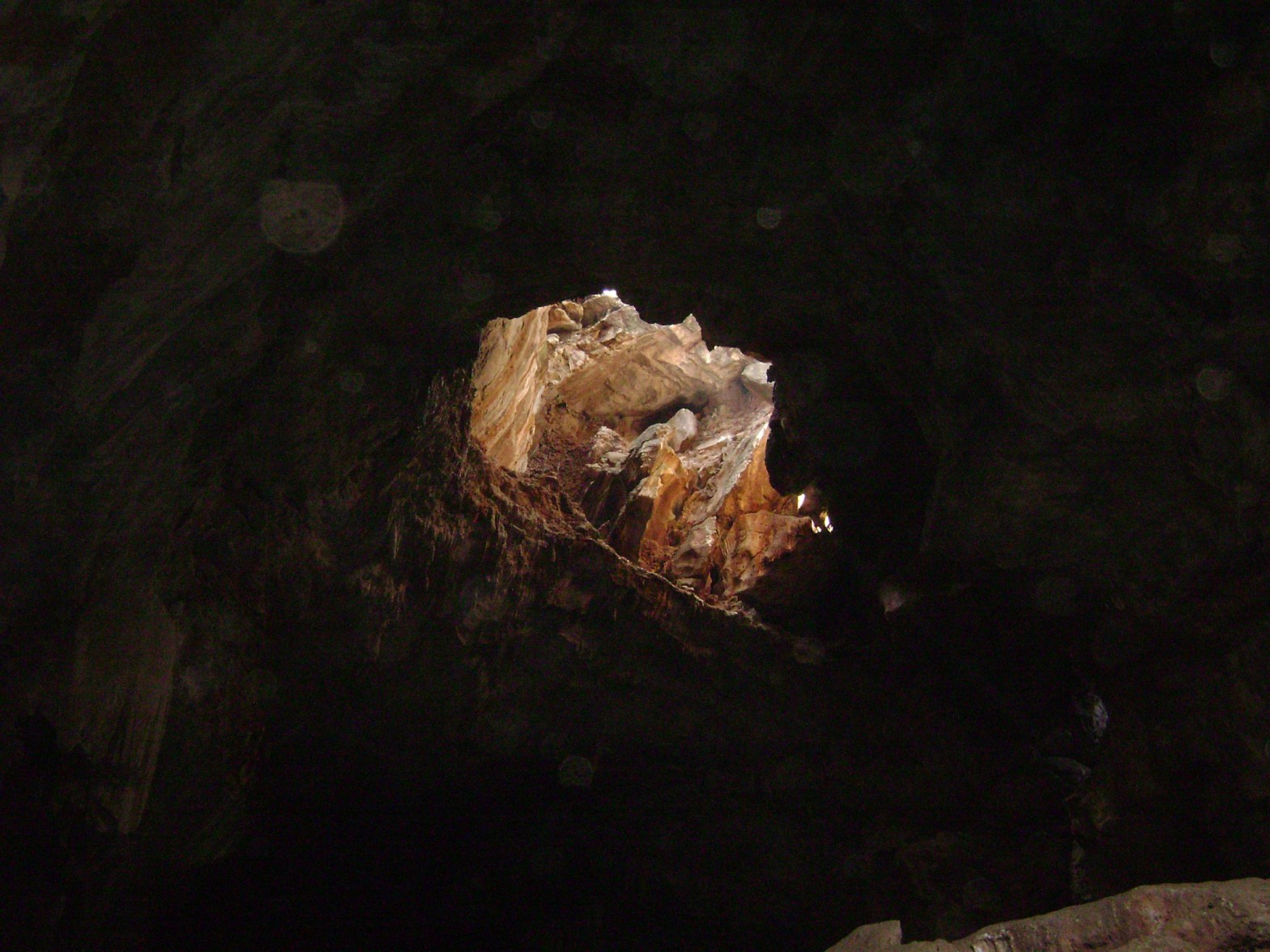
Stalactites and stalagmites figured from top and bottom. Some rose from the cave floor and some dropped from ceiling. They made a raft of baffling but picturesque geological layout. The temperature was a little low inside and the precipices along the wall at different altitudes were connected by stairwells. After traveling for some length it was completely desolate. Absence of tourists had made the already creepy feel stronger and I had it in my bones some alarm coming up fast. A few light bulbs flickered to make a frail halo.

We made a scrutiny of the wall up close in the hope of finding some primal mural but were disappointed. Artwork across the wall was indeed present. But these were baffling squiggles, occasional English letters displaying love lines and promises.  Doodles faded out in places, that did not carry much information and nothing from the Stone Age that’s for sure. The artists were none other than modern love birds.

A rain of fine- grained rubble drew my attention up at the corner of the ceiling where a colony of bats had built their nesting bed. A few crawled along the moist cave wall. These were fruit bats sometimes feeding on insects.  Bats couldn’t hold my attention for long. Soon after my gaze fell on a small group of tourists looking very tense.

They had lost one of their team mates who they searched with distraught.  Sign of fear blanched their faces. In a cave so dark and menacing, what would be the fate of this lost soul?  And what can cause a man to go trace less in a blind cave? There was no other way out. The whole group had their knickers in a twist.

Even in near darkness, the group confirmed he did not cross them the other way towards cave mouth. Mindless thoughts bred precarious possibilities. Presence of cenotes in Borra is very unlikely. If cenotes existed, accidental slippage into one of these could get him sucked in an undercurrent of whirlpool ! There was a chance he may have been hiding somewhere with mind-load of dark humor to scare his mates. Presence of carnivores? This would be the extreme of imagination, I have been reading too much these days and woke up to reality as wings fluttered around, bats were out on a flight for prey, guided by sound echolocation.

 Was not in a mind to explore any further the incident had a spell of bad presage thrown in. I asked the tourists to contact cave authority immediately instead of launching a panicked hunt ending in confusion. Having had enough of Borra Cave, I groped my way and made it to the cave mouth; being directly under the sky once again was a step closer to relief!

Not far from the entry point stood a restaurant nice and cozy. The cave nightmare kept haunting, the missing tourist incident not well digested and I did not have an appetite. Turned my back on the restaurant and set off for the Araku Valley in a cab that took almost an hour. The jitters evaporated as the cab sped through coffee plantations, dense forests and scenic landscape.

Chaparai, Araku:

Our hotel was close to the railway station with dedicated staffs and good food. We were lucky to get a room with a breathtaking vista in front. A line of casuarina trees offered a view before being lost in an abrupt turn. Beyond that, dense Eastern Ghats vegetation grew in a tight cluster. Our first destination was Chaparai waterfalls and it was about 10 minutes by car. 

We started early morning to capture nature at its best. The sound of flowing water was amplified as we approached Chaparai.  Chance of getting our feet deep in water was irresistible against a backdrop with stealing beauty. Yes, Rocks were slippery and in places they were in dangerous incline. When you look up at the source, million crystal blasts in a medley of glittery color. Water droplets were set in a dance of blinding white made intense by the midday sun. Yet it was a great feel to enjoy water splash with other tourists clicking for great photo opportunities.

Padmapuram Gardens:

 Picture courtesy: Tripadvisor

Padmapuram Gardens was not very far from hotel. A 5-minute drive could reach us there but we decided otherwise, could not defy the lure of making it on foot. It widened our travel horizons practically keeping us in livewire contact with the surroundings that sparked more zest.  A solitary walk in peaceful morning with color of spots here and there was a desirable pursuit. If it was a hovering butterfly now it was bush of bright yellow flowers the next moment.

A rolling fruit struck my foot. Looked up and spotted a monkey, the act fits him. Must have thought what is distasteful to him must be delicious to me or perhaps it was a welcome gesture in his own way. Sensing my indifference he stealthily moved on. Must have found some other engagement.

A couple walked in front a few meters ahead munching on cookies and stopped by a local vendor who offered fried cashews.Half eaten cookies disappeared in travel bags. Cashews looked more engaging to the palate and seller and the buyer swapped smiles. The monkey had finally caught a lizard that it may have been trying to stalk. Traveling by the car would reach us to destination no sooner we would board. But we would miss these simple charms of life within the confinement of comfort designed in metal and chic upholstery.

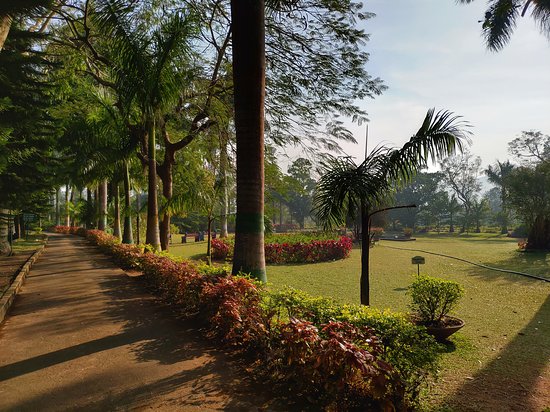
The garden was neatly groomed. Diverse flora ranging from known species to exotic kinds kept me occupied. It may be a haven for botanists but no less enchanting for nature lovers.  Rare breeds, ornamental flora, shrubs and tall hundred footers coexisted in an amazing habitat. Plant feed and water were well taken care of by the Araku botanical garden authority. Landscaping was beautiful and life-sized models of prehistoric reptiles kept the kids running around, beaming with vigor.

A lot of thought goes into sculpting these giant dinosaurs. The impact on tourists’ psyche, the effect of possible fun and fear on kids’ minds in particular is a significant factor. A well maintained nursery was a stunning show stealer that demanded around an hour of intense study. Saplings in tubs were nursed with affection before making them ready for journey through adulthood. Padmapuram garden is a laudable endeavor. It deserves a repeat visit!

Tribal Museum:

The tribal museum was about 10-minutes walk from our hotel, a nice place to explore the life of the Eastern Ghat tribes. There were separate sections for masks, game weapons, pottery, bird traps, indigenous jewelry and clothing. The stuff behind glass cases offered a vivid display of tribal lifestyle. Among museum visitors, a reasonable proportion belonged to local communities. It was an eye-opener that visitors showed such keen interest. The way the museum had portrayed their way of living is a reflection on the long journey from the days of hunting- gathering to spending time on social networking sites.

Have their lives been simplified by the advent of hypersonic tech world? The bait of gimmicks and its visible impact was what was expected from ethnic races amid new found globalization. For a frank opinion I was a little surprised that they were here instead of browsing net in a cyber café.

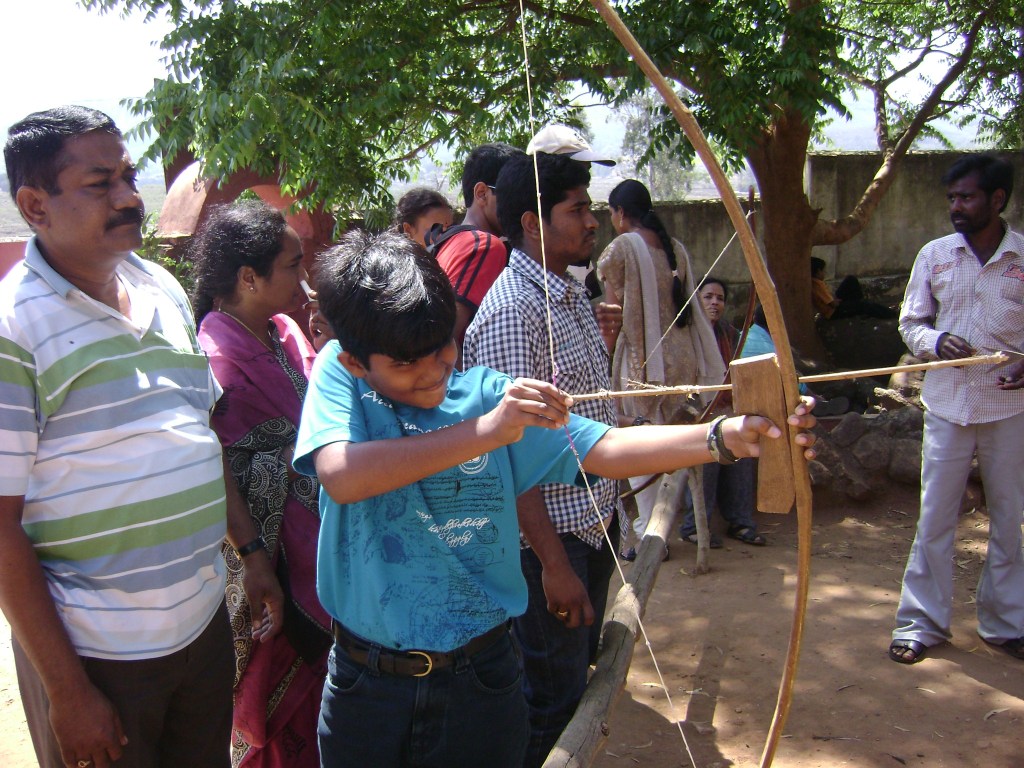
Walked a few yards to watch a fun archery competition held in the museum premises. Not to celebrate the marksmanship of participants but to have clean fun and skip where participation was more important than how one performed. My kid joined in the fun and later declined to continue after missing the target by clear half a meter! 

There was something more to keep us absorbed. It was the Dhimsa tribal women who danced to the tune of a flute player and a drummer performing in concert. It was a wonderful combination of grace and class reinforced by an arresting springtime flavor.  Appreciated the purpose of Museum Authority to showcase the cultural essence in all possible ways and what can be a better place than the museum premises? You get a glimpse of the culture and contribute to the sustainability of locals.

 We were back by sundown. The night was almost as transparent as daylight. The full moon night will follow through to the festival of Holi next morning. Hotel staffs had organized a bonfire, a familiar ritual prior to holi. Makeshift structure of twigs and dry leaves get set on fire. Significance of this bonfire and its connection with the festival of color had never struck my mind. The only link lay in the soot left behind after the structure burnt down.

I recall collecting and rubbing soot across known faces I could lay my hands on. Instant gratification cared a fig for consequences of damaged relationships later. It was a lazy morning. As I was sipping coffee, my glance set on what all lay in front of me from hotel balcony. A black heap lay in a mass of charred ashes. This could have been a source of fun on the day of festival. But no one ran around with color. We finished a quick breakfast and set for coffee museum near Araku bus terminal. 

The museum elaborated on history of coffee cultivation and farming methods. The guide spoke about ideal weather and temperature conditions, methods of farming, harvest and drying the pods and processing into powder. It broadened my knowledge with some insight. A strong aroma wafted from every corner of the room. It was quite crowded. We sampled the brew, it was strong.

Tyda Nature Camp:

Araku valley trip is incomplete without Tyda nature camp in the itinerary, located about 35 kms from hotel. I was in two minds whether Tyda would be a worthwhile trip, wasting a precious day in jungle instead of planning something sensible is not a viable option. It would have been a mistake not to give it a try as it turned out very soon. A human settlement at the foot of wooded Eastern Ghats is the landmark.

As usual we started early; the cab drove along a sliver of road that was in bad shape.  The possibility of an accident cannot be ruled out. Thought of the missing tourist in Borra caves snaked across my mind adding to uneasiness that was still roiled in my core. I hastily cautioned the driver to get a hold on car speed. Going full steam is fun but certainly fatal once you lose control on grip.

The net connection was going erratic and trying to get hold of it was becoming a task. Tyda nature camp was terrific. It was a wet Tyda a half an hour’s rain came in light showers that was improbable in this season, Araku doesn’t get a downpour until late June. The forest woke up to our footfalls, a variety of bird calls responded to our presence. It didn’t sound like a warning against an unauthorized entry. It was green with dense bushes and trees shooting well over hundred feet into the sky.

The need for sunlight was a strong stimulus in response to which they grew in contest. Tree top foliage blocked out the sun casting a patch of gloom at the base. We stopped our car and relaxed outside pacing the ground back and forth with a hope to see our winged hosts. A luxury resort called Haritha Jungle Bells stood in tranquil forest.

It offered a splendid staying arrangement. Haritha is itself an attraction in Tyda Nature Park. Located at a height of 1000 meters, the resort promised luxury. The interior with tasteful decor was apparent from its up- market exterior. A nice and secluded nook to spend a few days shut out from the bustling city. It was a little out of the ordinary to find a modern structure in timber and concrete amid a vibe where harsh nature rules.

We stopped only for a few minutes here, we are to move on. Staying at Haritha was not our plan partly because it was expensive and partly for our tight time schedule. For those who can swing it financially, it is a fabulous stay. We drove straight ahead and so far field of vision could take us it was all green. Wildlife included rabbits, lizards, blackbucks, macaques and a number of bird species.

But luck wasn’t on our side we could see only a couple of rabbits scuttling in fright when our car almost ran into them. We parked car and went on foot to get some jungle trek. A hanging rope bridge was quite a dare to call up all courage and make it to the other end. Jungle safari and struggle to move through jagged ground was a big time amusement.

No transmission towers.  No mobile alerts, we were disconnected from the civilization.  Being off the grid poured on us blessings of digital detox ! The surrounding was absorbing. You won’t feel an impulse to sneak at your digital apps even if it was working. On our way back, we had bamboo chicken in Haritha. It was yummy! Thank God the restaurant is open to outsiders. Else finding a suitable eating place to refuel after a long trek would have been an ordeal.

Tyda nature camp is a torch bearer of sustainable tourism. Coffee, grain and veggies are all sourced from local farms. It is easy to mislead tourists mixing lie with traces of truth unless you are an expert at identifying cues of false claims of sustainable tourism. But Haritha’s efforts looked honest and not hyped by greenwash sewing up deals with professional marketing agencies.  Neither was there any environmental abuse by way of dumping garbage by resort housekeeping nor did the tourists litter the ground with plastics and non biodegradable refuse. 

After gathering a pleasant experience of Araku valley over a span of three days we started back for Vizag on APSTRC Bus. The valley is a hidden jewel in the crown of Eastern Ghats. This underrated destination should do better in terms of promotional exercise to achieve a bigger volume of tourist draw. Then again, the larger the numbers of tourists, more deeply pushed in would our carbon footprints be. A vicious cycle will fall in with head chasing the tail unless tourists themselves turn a little more responsible towards environment. Well, we hope for a sunrise someday!

Our journey to understand you better

“The journey, not the arrival matters” – T. S. Eliot

Covid cannot hold you from exploring…..

Simplyroam promises to take you through exciting journeys to much-heard of destinations as well as the lesser-known spots giving you the opportunity to rediscover and reform your likes and preferences.

What is liked by all may not be liked by you. Simplyroam allows your mind a free exploration to different forms of travel that you may have desired but not dared. It may have stirred your curiosity but could not be fulfilled. You may have longed for a choicest destination visit but could not make it owing to many reasons told and untold.

Simplyroam reads you better. Your preferences and distastes dwelling deep within. So stay tuned for our latest updates in travel trends, destination updates and easy travel tips to make your sojourn the most memorable events; events that you won’t stop talking about.

A cultural pilgrimage to Shantiniketan (The Abode of Peace)

20181215_122357

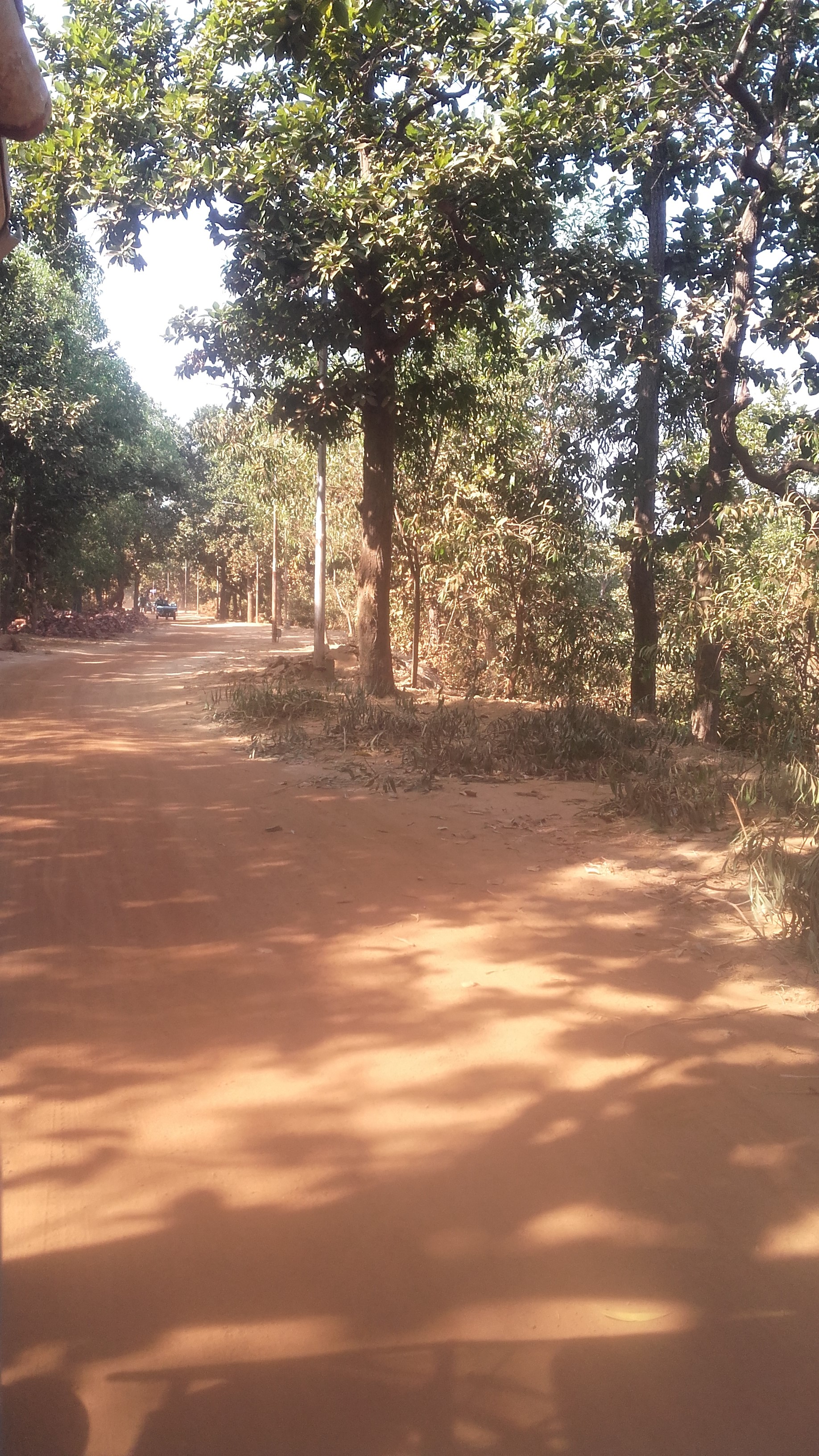
A weak net connection was disrupting my focus. Several attempts to book a reservation from Bolpur to Howrah failed. I had asked my Toto ( Tuktuk, the battery operated three wheeler ) driver to take a break. Fingers failed to connect the right buttons  as the ride along dusty trail was far from uniform.

The vehicle was  parked beside a shade of Sal grove. Sweet melody poured out from a  mud house  amidst the grove. Visit to Shantiniketan (The Abode of Peace), Bolpur  had been in my mind and this  morning  I could make it!

20181216_151344

Shantiniketan – The Abode of Peace:

Peace and tranquility reign in Bolpur.  Once an unknown part of rural Bengal in East India caught fancy of Maharshi Debendranath Tagore, father of  Rabindranath Tagore. Densely surrounded by huge Chatim trees and Sal groves, he discovered this place appropriate  for reconnecting one’s own self with the surroundings and thus the name Shantiniketan, meaning the Abode of Peace was rightly suggested.

The kaleidoscope of Bolpur got set in Tagore’s dream of raising a culture of broad based expression of mind and thoughts. Embracing diverse cultural landscape scattered across the globe was  core of the equation.

Literally, an abode of peace, here every support is available for shaping impressionable minds and sharpening  intellect . What is so special about the place making it a global cultural hot spot acted as a motivator.

Tagore’s Shantiniketan – Evolution of Indian philosophy, art and culture:

Shantiniketan and Tagore are inseparable in Bengali culture. While the world gets acquainted with Tagore through his words, one feels fortunate to explore a place where a personality of this stature had once made priceless contributions.

The Kanchenjunga express left Sealdah station sharp at 6-35 in the morning and was scheduled to reach Bolpur around 9-15. It was a little foggy. December had started its bite of chill.

Checking into the hotel wasn’t possible before noon but the reception offered a piece of valuable advice. That we book a Toto, start right away, wander along the  enchanting landscapes of Bolpur all day exploring Khowai, Kankalitala, Kopai river bed and sections of greenery that would come in our way. The journey would take a rough 8 hours after which we would rest in the hotel.

Apart from Shantiniketan, this rural area has other interesting aspects of cultural and tribal tourism rich in vibrant folklore, folk music and traditional art that is no less interesting. The place has the right kind of fodder for the culture-craving souls.

The next day, we can do Uttarayan, the cultural hub of Tagore estates covering the art galleries, museums and exhibits of priceless artifacts and Visva Bharati University Campus.

Kankalitala – The revered Shaktipith (Shrines based on Shaktism reflecting the power of Goddess):

Mythology associated with Gods and goddesses forms the pillar of rural Bengal culture and Bolpur is no exception. Kankalitala was about 8 kilometers from our hotel. A temple by the banks of Kopai river is a seat of pilgrimage.

Legend has it in the event of Tandava Dance by Lord Shiva, Lord Krishna intervened and stopped the universe from facing destruction cutting off Sati’s corpse by the Sudarshana  Chakra. Body parts flew in different parts of the country and the waist bone (Kankal) fell right here in Bolpur, Sriniketan. Thus, the name Kankalitala, a sacred site with a temple erected for worshiping Shakti.

The sky was bright. As the Toto sped along red dusty trail, cold wind struck us on the face. It was pleasant and relaxing. As usual, the temple was crowded with pilgrims. Hawkers peddled their  trade of  handicrafts and heaps of  sweets stacked inside glass. Business was smooth keeping efforts of vendors well sustained with cash flowing in from the tourists.

Sun rays threw a comfortable warm shaft on the temple frontage that felt good in the cold morning. As always, the entrance to the temple was crowded with derelicts. Plea for aid  made strong  by  display of whatever skills left – playing the ‘Ektara’ (one-string musical instrument largely used by folksingers of Bengal) and worn out harmonium. An effort to survive the curse of penury is a matter of compulsion. Choice has no place in their lives.

The charm of  picturesque terrain of Birbhum (red-soiled district of which Bolpur is a subdivision) unfolded as we raced along open plains.  Bright yellow mustard fields  ended in rugged plateaus of brown and green meeting the sky in the horizon.

By the side of our travel route, we spotted occasional homesteads enclosing groves. Almost every house here has a patch of green in the yard. Some belonged to locals and some owned by people from far-off places like Kolkata.

They spend here a relaxing weekend away from the  rumpus. Even putting their own properties up for vacation rentals is in trend. It is an excellent way to experience vacation as a local, staying in a residential area instead of one catering to typical touristy environment with a lot of hotels around.

Moving past  a wintry rural setting I was fascinated by fields that lay in rustic beauty where crops have just been harvested. Trail of bullock carts looked like formless long lines punched in red mud. We rode past  bards, threadbare and wretched who played string instruments under tree shades in run down humor that didn’t apparently betray  any troubled thought about  spending the next day. Poverty existed and possibly it did not make a dent in their elevated spirits.

Prakriti Bhavan – Nature art display:

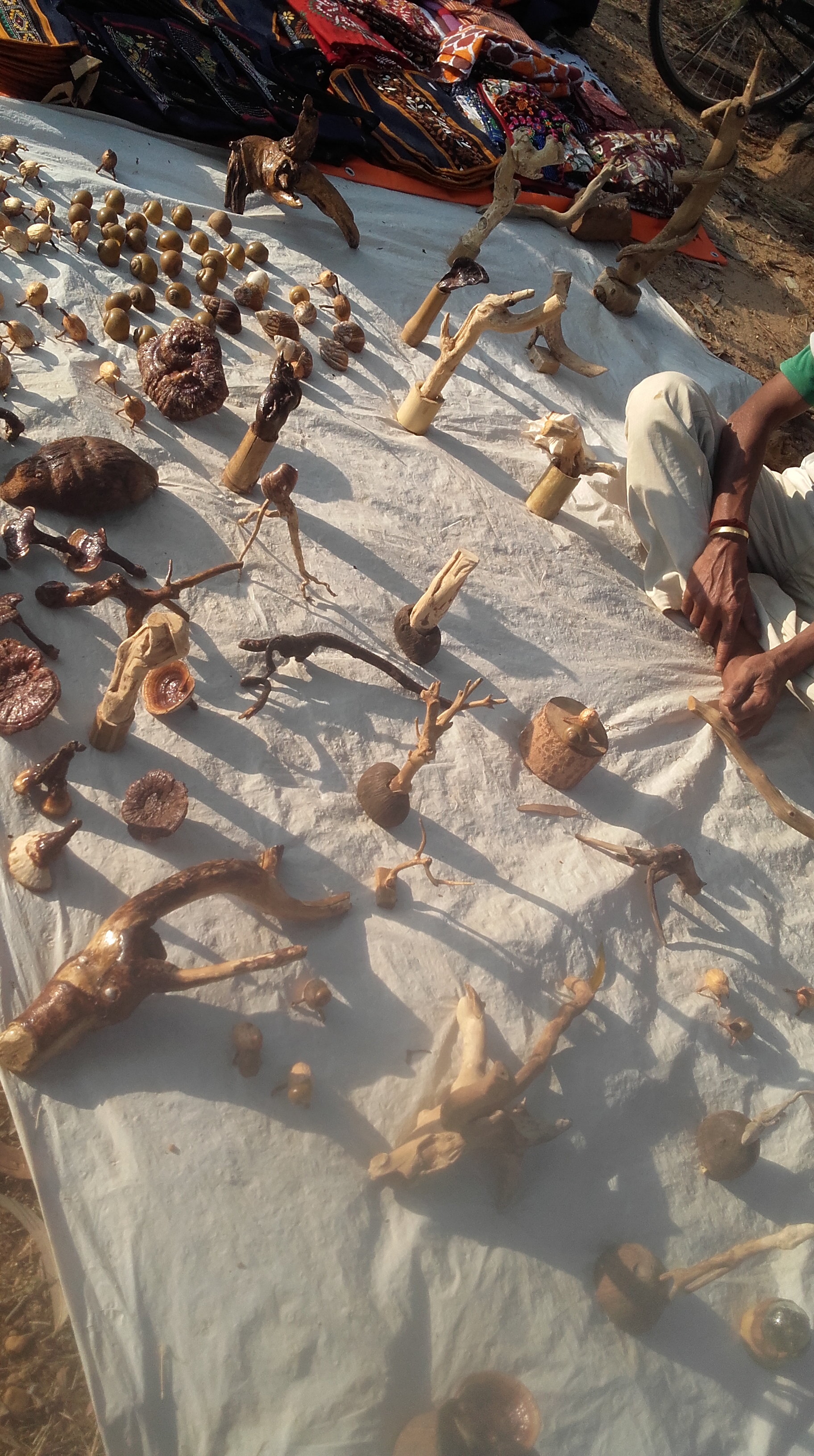
We reached Prakriti Bhavan after half an hour. Nature artists have identified special features in natural formation of wood, tree trunks, branches, stones or metal parts. No additional sculpting or chiseling was  needed to achieve a definite shape or form.

It is the artist’s keen eye by which he could identify a bull head, bird, serpent or a cow from the naturally-shaped wood, stone and metal parts. An inexperienced eye is likely to miss these hidden objects. An official guide was doing his best to explain subtle nuances between one model and the other.

But  his  narratives soon lost audience to more visually pleasing  open air garden with natural rock sculptures  evincing  effort to connect man with nature through music, art and poetry.

Reasons for this displacement might have been either the guide’s sermon wasn’t very compelling or audience might have suspected paying too much attention to  all what he  said would end in a commitment for payment. It is wiser not to wait for the moment of embarrassment.

Srijani Shilpgram – Eastern Zonal Cultural Center:


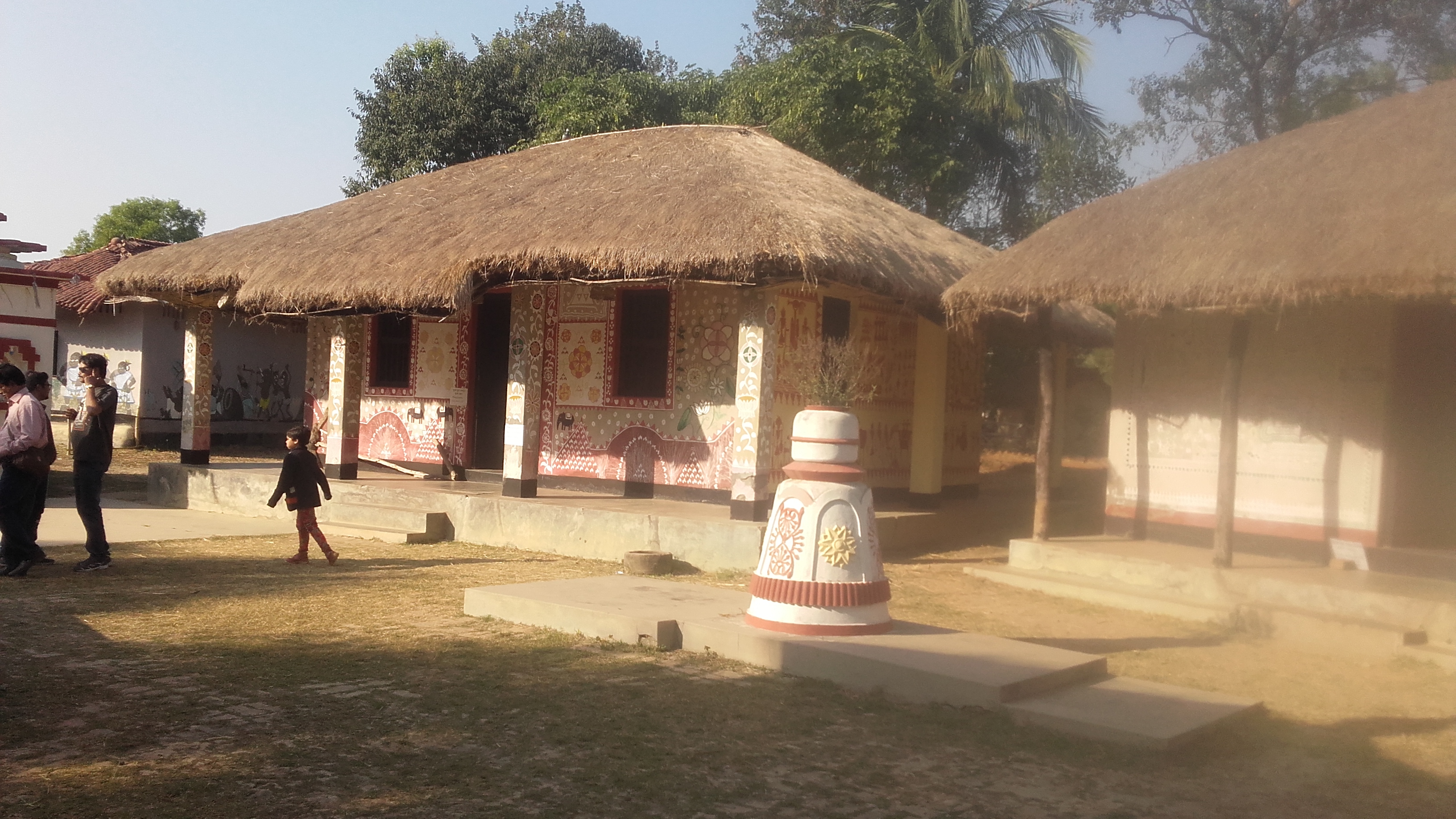
Srijani appeared soon after, a melting pot of culture of eastern states of India with beautiful carvings and clay models.  The expansive space dotted with intricately-chiseled models, rock art and artifacts is simply mind blowing. An ideal place for art lovers and shutterbugs where one won’t mind spending an hour or two admiring art intermingled with natural beauty.


The artwork on the walls of small rural huts, each representing 8 eastern states of India was a feast to the senses. A stage has been set up giving an opportunity to folk-artists display their culture through lively music and dance. 

20181215_142709

A well-appreciated government supported platform to sustain the dying regional folk art.

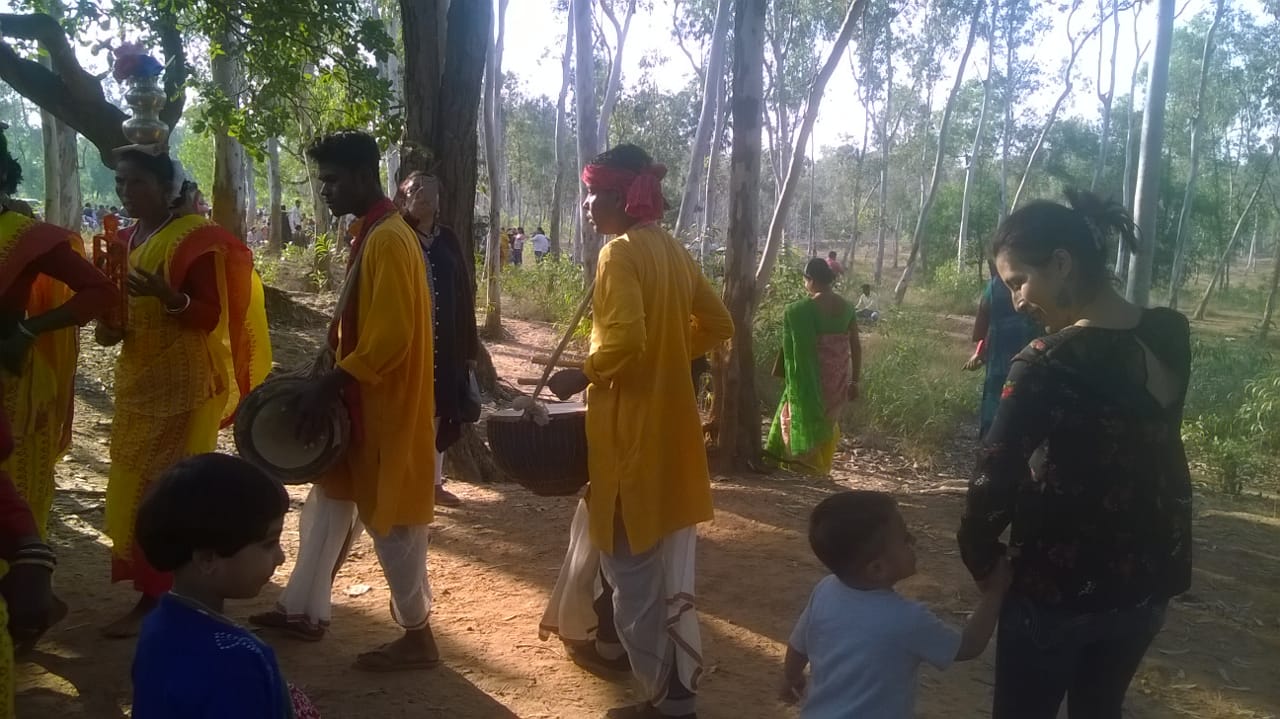
A dance troop from Chattisgarh performed on open air stage. Pleasing music, vibrantly colored attire and the rural musical accompaniment treated us to a different world . Body movement and rendition are powerful enough to hold us spellbound even if  the lyrics are beyond grasp. Tune was drops of honey to the ear.

Rangabitan Tourist Complex:

We crossed Rangabitan, a West Bengal government tourism department lodge  complex, set amid Birbhum red mud magic, quaint woods and a mango garden. The accommodation  is reasonably priced answering the needs of  tourists well.

Amar Kutir (My Home):

Amar Kutir is where a large handicrafts center is set up. This is a time honored  institute featuring  endeavors of Tagore  inspiring the lives of locals, nurturing and molding their innate talents. A great example of sustainable tourism supported by the government.

Producing handicrafts and farming is not just an end in itself. Follow ups for locating a demand for niche skills to market the produce completed the cycle. The handicrafts center was a razzmatazz of delicate artwork.

A little expensive with an amazing finish, the wares stood in racks. Brittle clay pots and glassware were way too enticing.  “Once broken considered sold” was a standard tag that did not deter us from close exploration of the genius the terracotta  held.

The restaurant in Amar Kutir offered a gratifying lunch.  One cannot but help admiring food being served in brass cutlery, an honest effort to keep up with the long lost Bengali culture.  Coupon system of buying food was in vogue. A long wait between buying the coupon and receiving the plate made us somewhat grumpy.

The wait was at last rewarded with awesome food served hot! Spoons and forks hung on the stands. Piping hot Bengali lunch is not a ritual of knife and fork. It wouldn’t taste the same eating with fingers adds to its sumptuous voyage.

Sriniketan:

Visit to Sriniketan was a journey along a desolate road lined with trees on either side. A deserving enterprise by Tagore for agricultural promotional efforts who strongly believed uplifting Indian agriculture is important for the sustained growth of our nation.

A school imparting knowledge in skills and tricks on farming was meant for children from local hamlets who would learn and implement tricks of the trade for well-being of rural colonies. Irregular twitter of birds subscribed to unspoiled pastoral vibes.

Not very far was a Kali temple on the banks of  lake Krishnashayar. Mood was held in an awe-inspiring silence. In the temple yard stood a sacrificial altar.  A somber note hung in the air no matter whatever might have been the number of innocent animals butchered here, the haloed ground will  continue to be sanctified.

Ballabhpur Wildlife Sanctuary:

Ballabhpur deer park came in our route. The forest has a large herd of naturally bred deer. Existence of nature so close to Visva Bharati campus life opened up a man – nature interface that is necessary for much needed respite.

Established in 1977, it is one of the most successful deer conservation center. Large water bodies shelter a host of  birds welcoming seasonal migratory species as well. A  diversion from art and cultural exploration to observation of Cheethals and Blackbucks from close quarters is a desirable break.

Shonajhuri Haat – A signature blend of cultural and tribal tourism:

IMG-20190302-WA0022

It was a Saturday and Sonajhuri Haat ( rural market ) was as usual in roaring trade. A mela on the banks of Shyambati irrigation canal offered locally handcrafted jewelry, decorative pieces, cotton clothing and delicately chipped statuettes.

The Haat is laid out along one of the tidiest forests I have ever seen with its floor carpeted with flaxen Sonajhuri flowers. The atmosphere was pollution free and vehicles  not permitted inside the forest. Swarm of handicrafts men collect  from villages near and far vending produce from morning till sun down.

20181215_153032

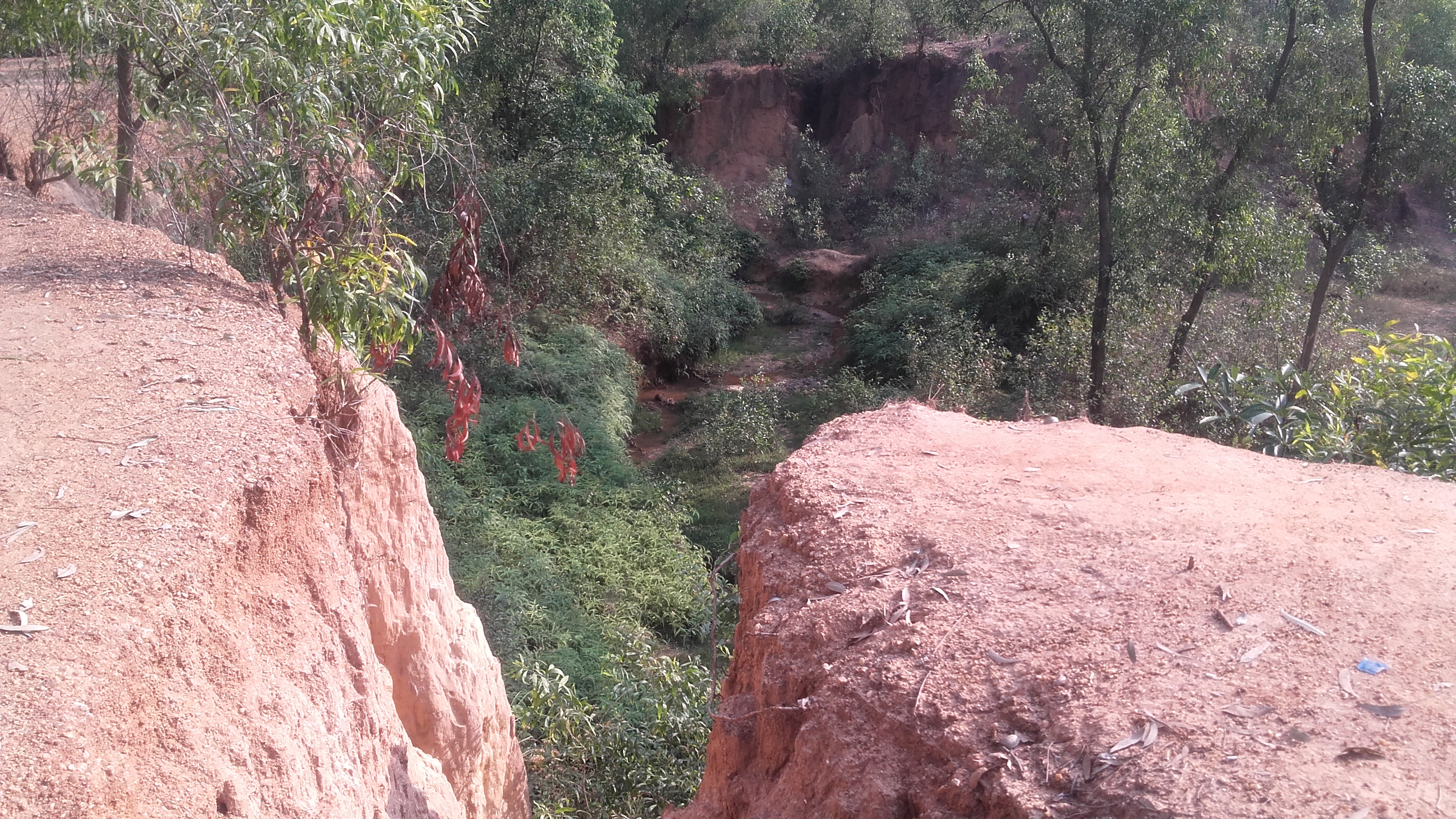
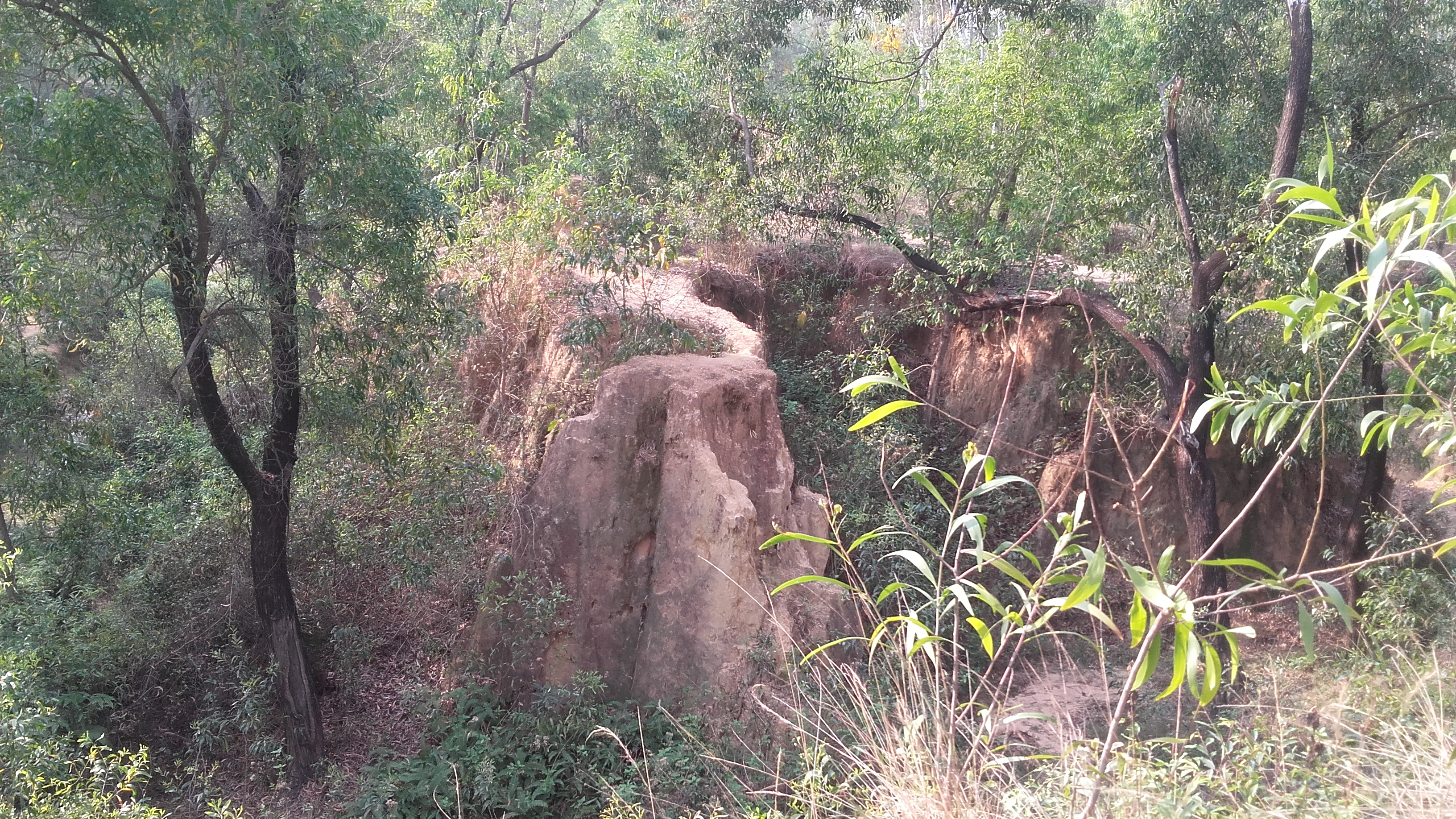
Local folk dance and Bauls (folksingers) playing ektara  had an offbeat charm. Presence of natural formation of Khowai (a local term for soil erosion) in which Sonajhuri Haat is set added to its landscape beauty. Evolutionary development of small canyons from erosion by wind and river had wonderfully fused with the extreme eastern tail end of Chotanagpur plateaus.

20190317_080855


Haggle for prices is common and we bought some embroidery and craft work and ate pot full of Raabri( milk condensed on low heat and flavored with cardamom) that the vendors carried  on bamboo poles rested on shoulder.

It was around 5 in the evening and our shadows were cast long by  sun that would be in the sky for a short while. We headed  towards Kopai river bank. Our route was along a labyrinth of mud strip winding past  a tribal village.

This tributary of Mayurakshi river runs dry in summer and winter but spills over its banks in  wet monsoon. Soil is purple featuring ravines on the banks that had run for miles melting into wilderness in far off fringes. Decades ago,  packs of wolves roamed the grounds, they had been a part of local fauna now extinct.

20190317_080152

Inspired by the  pristine beauty of the region the Nobel laureate had composed immortal lines themed around Kopai river. A choir of singers  were rehearsing passionate numbers in  the backdrop of  red sun in its fading blaze that was about to sink. Our shadows seemed elastic they grew  in length.  A cold breeze blew in from the North. We boarded  Toto and moved in the direction of our hotel.

 Visva Bharati Campus & Museum:

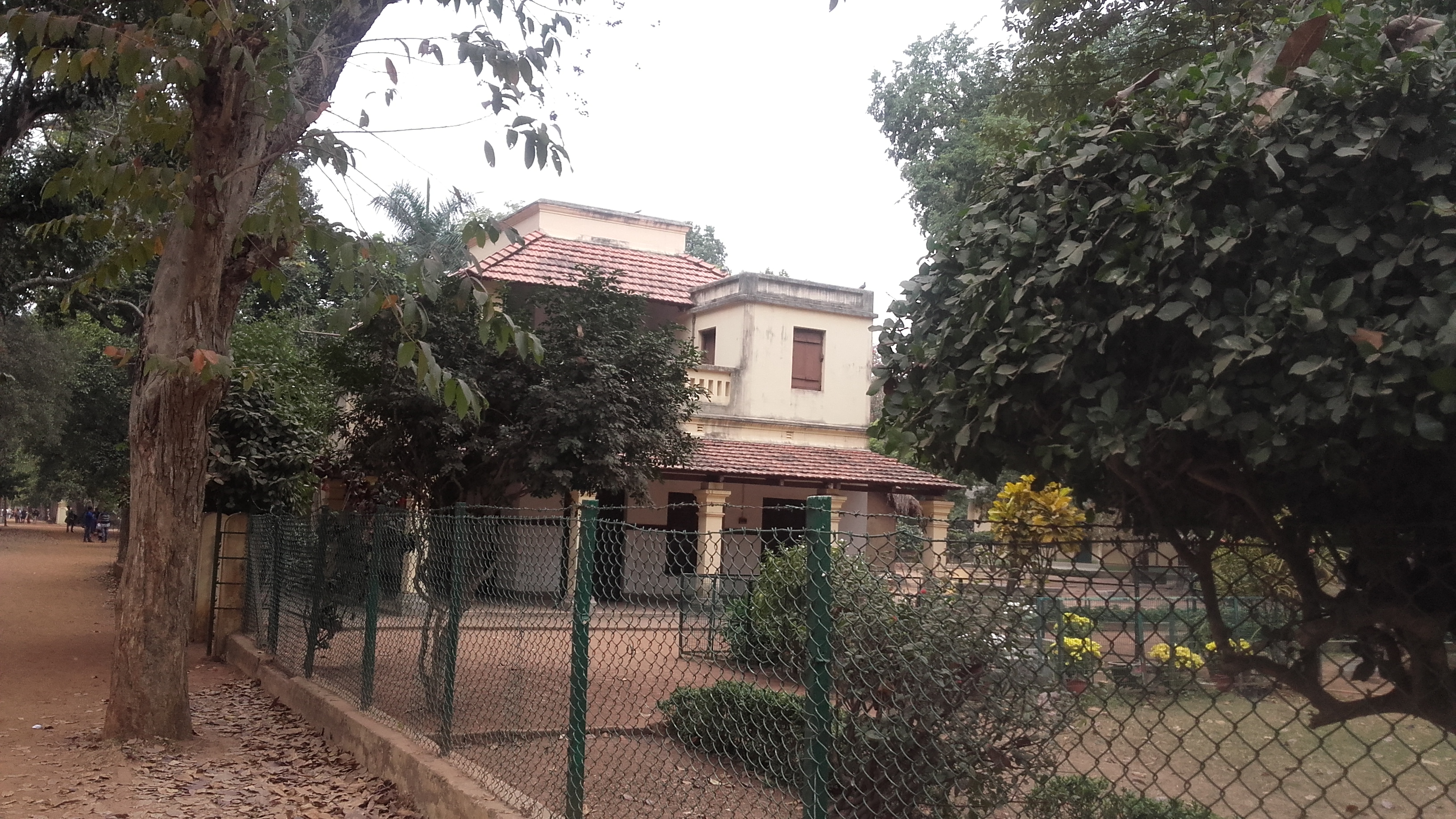
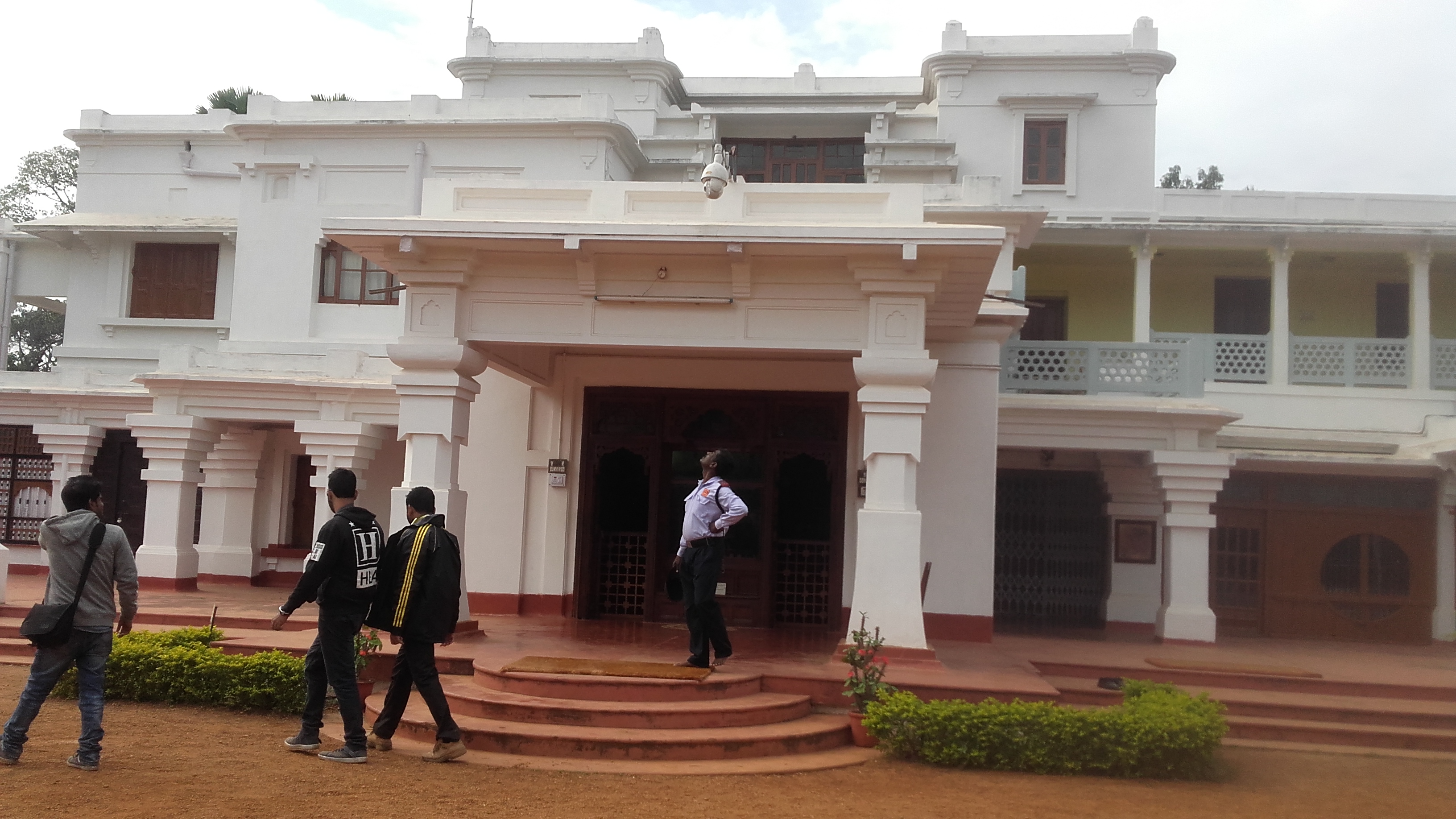
Started around 9  the next morning. First stop was Rabindra Bhavan. Viswabharati  University building premises darted back as we moved ahead. Hostel buildings , Ananda Pathshala ( elementary school for kids established by Mrinalini Devi, Tagore’s wife),  the iconic Taal gaach (palm tree) shooting out through the thatched roof, the sprawling  Amrakunja (The Mango garden) ending in  majestic edifices and abstract artwork came in a row.

Tagore’s presence was felt everywhere. A tight security was in vigil. Vehicles were not allowed to stop save a few selected spots. We kept moving, awaiting a chance to stop and click the camera was hard though I had some success in my attempts.

Statues created by the renowned Ramkinkar Baij assumed an assortment of shapes. They are not chiseled with hand. Mounds of soft mud stand as a target and you got to chuck stones in soft mud until your dream is realized. It is far easier said than done but conveys a message if you are strongly driven success cannot be far away.

Rabindra Bhavan – The heart of attraction:

20181216_120122

Rabindra Bhavan housed a museum and that is fabled. Here 5 homes where Tagore stayed in a cluster known as Uttarayan complex draws tourists from home and abroad. Pieces of antique furniture and decor  is a reflection into a bygone era Tagore spent here in quaint peace spinning his gossamer dreams  that would have a profound impact on the society .

It archives 1580 original paintings by the laureate himself and 554 done by others. Besides 11380 priceless photographs, 3855 curios and 52 statues and certificates , mementos and memorabilia connected to signally fascinating aspects of the Poet’s life are all set in an absorbing presentation. Events from the past fascinate.

At times it becomes hard to reconcile the modernized thoughts and global quest for knowledge and information that boiled inside the poet in a timeline more than a century old.

Heirlooms were numerous and enchanting , like coffee pots presented to Tagore by tribal chief of some obscure African nation or a watch case set in ivory awarded by king of Siam truly attest to the fact that the man had an astounding global influence. Photography was strictly prohibited.

An international acclaim was bestowed when media of communication and logistics was way too primitive. He had succeeded immensely to put across his thoughts and tabled his hopes and fears on a global platform and that too in a regional language. Well that is another story my thoughts and words are too weak for an analysis.
Continue reading “A cultural pilgrimage to Shantiniketan (The Abode of Peace)”

Sacred stones of Angkor Wat– Cambodia

IMG-20180812-WA0012

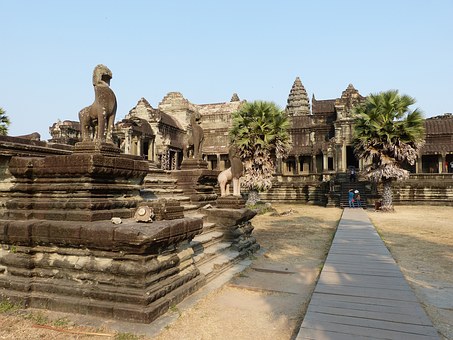
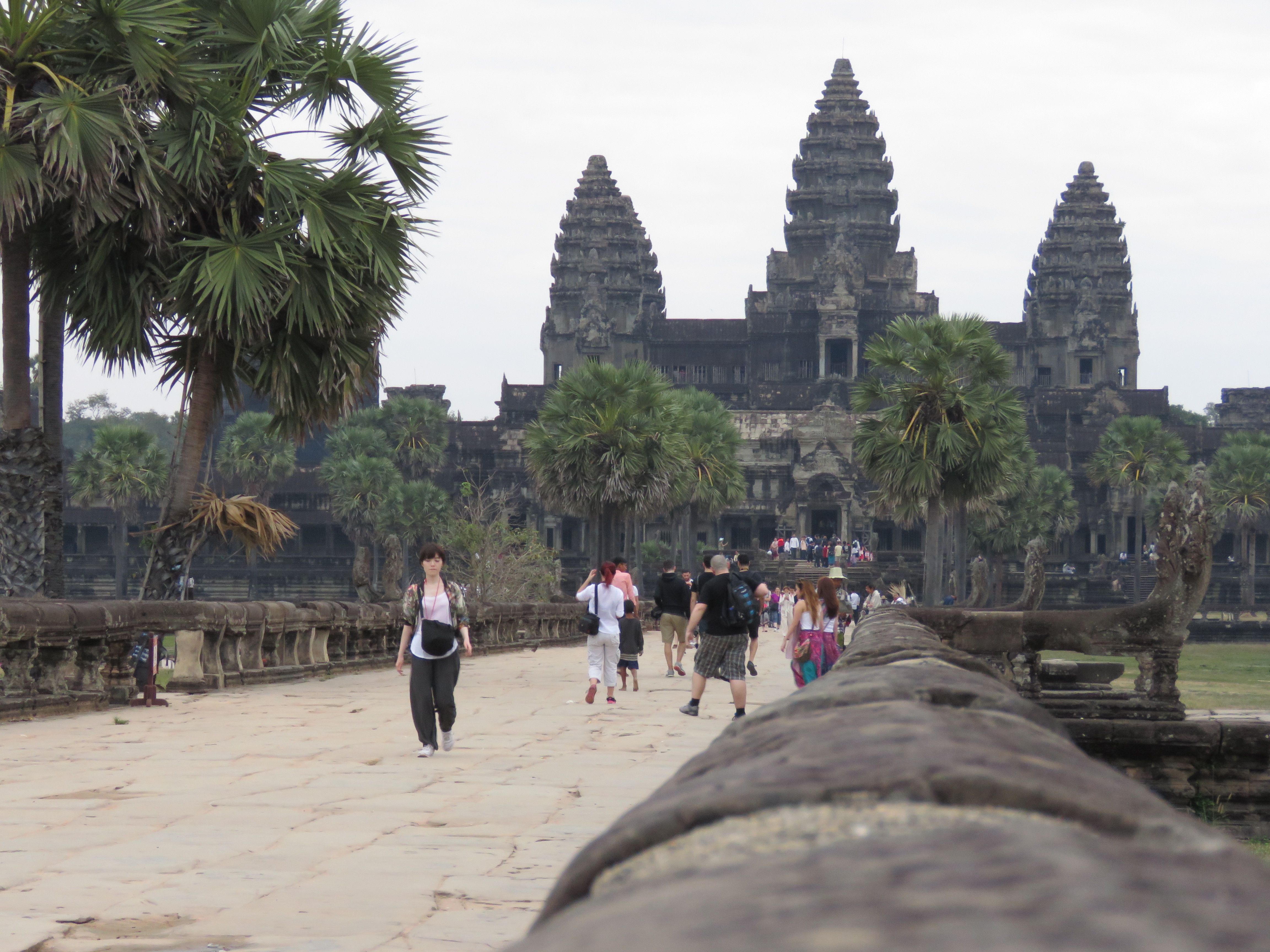
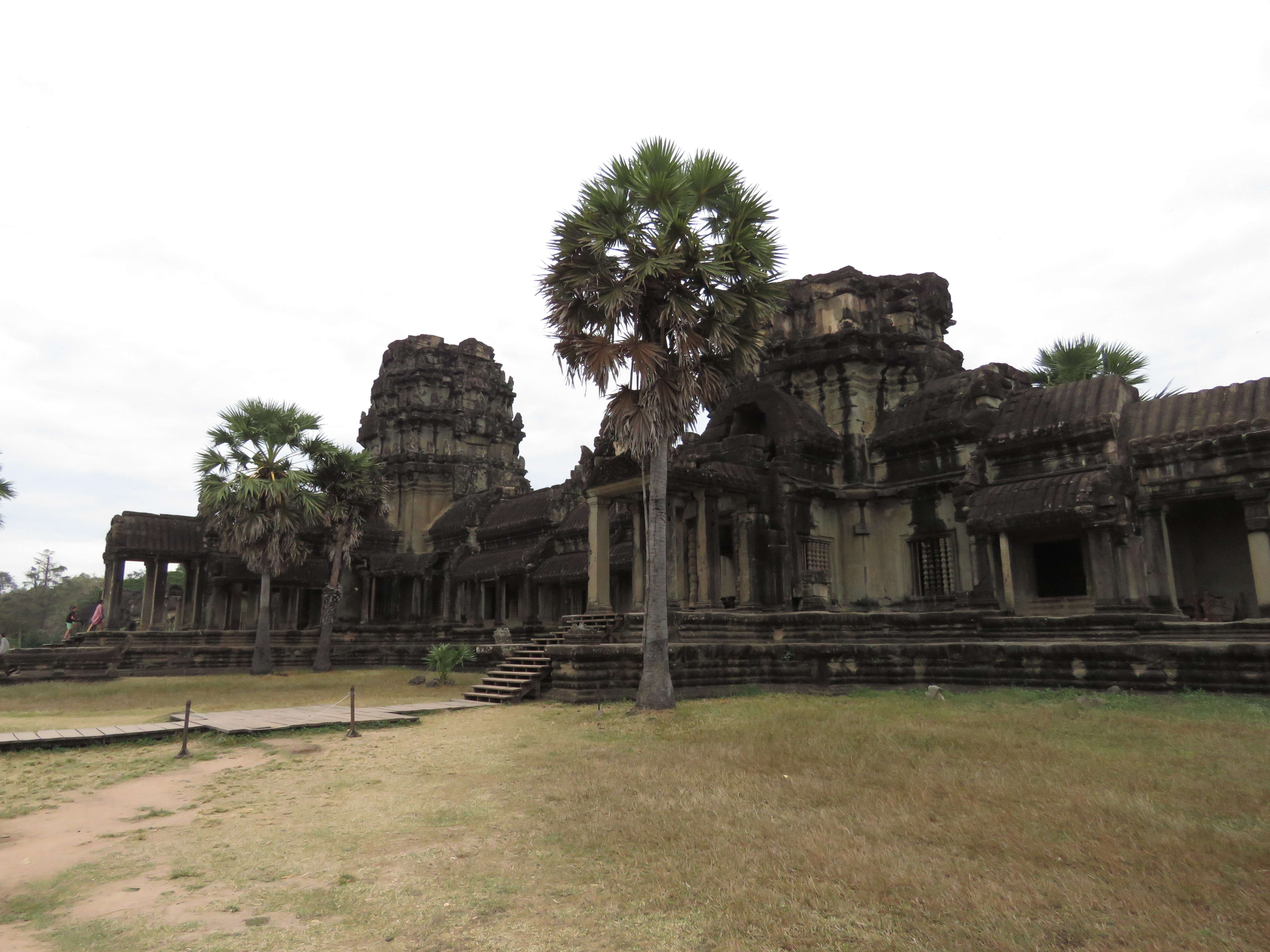
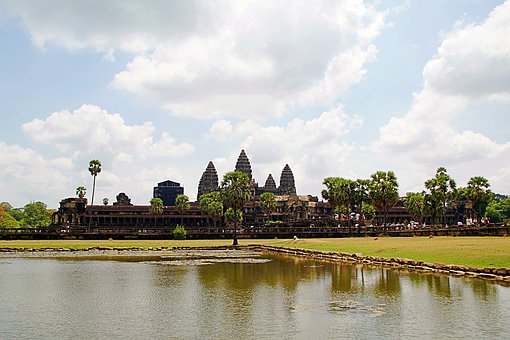
The imposing temple of Angkor Wat had always been a magnet for tourists. The beckon was irresistible to me as well. My dream turned up in 2001. Made travel arrangements and packed my luggage boarding a flight bound for Cambodia.

Angkor Wat 6 Banyan roots

AngkorWat – a way out attachment to a culture extinct and buried! Sheer size is awe-inspiring, the rich interior tempting and so are the crumbling structures. They stand scattered with a crown of Banyan roots sunk deep down to the temple floor. Rustic vista of Cambodia is fabulous and a short sojourn into the pastoral landscape before getting to the temple site will not be a bad idea.

The drive along the countryside was a beaut. An easy going feel held.  No sick hurry and I was far far away from the grind. The chaotic hustle and bustle was absent.  It was all green in the horizon. Lush paddy fields lay in silent calm where farmers pushed through knee deep water. Long- blade ploughs followed their water buffaloes and pointy headed rice hats looked iconic. An ancient method of farming indeed but the region is productive. An indispensable rice bowl to feed the country’s  entire population.

Having said that, once I set foot in rural Cambodia I was admiring the landscape moments later. Tall palm trees stood across paddy fields and occasional kingfishers dropped from sky for fishes. Storks and Pelicans moved gracefully across swampy marshlands. Their way of walking wary and heads bent towards water that offered promises. Fish and shrimps, crabs and snails, snakes and frogs are profuse in shallow waters.

Angkor: 

angkor-wat-3

It is a story of hard earned peace, the country has witnessed strife and human sufferings  decades back.  It has also seen expansion of art and sculpture long long back making it to pinnacle of repute.  A rich culture thrived turning South East Asia a glowing spot in the history of civilization.

Dark clouds gathered overhead in late 70’s. The autocratic Khmer Rouge  had put a stooge for mass genocide wiping out a quarter of Cambodia’s population. The motive was complete elimination of political rivals. And the deputed General precisely willed to do that. Civil war broke out, death and panic ruled.  Grief tourism takes you to exhibits of death and pain, silent wail rising from remains of mass annihilation lost in limbo. This is now history that we do not like to recall. What we desire is to go back further into  first half of the twelfth century. This period Cambodia had given the world its mind-blowing  gift : The Temple of Angkor Wat.

The legend of Angkor starts in ninth century when the juvenile king Jayavarman II ascended the throne. He had set up his capital near Kulien mountains. Showing potential from an early age he unified small independent warring states.  Seeds of power were planted and followed through .  Hopes of a distinct civilization bloomed. Growth and prosperity transpired. A smiling Sun shown over Cambodian sky and the moon cast its grace with angelic glory.  One of the most formidable and authoritative empires in South East Asia was thus  born .

Check the video link for more intricate details:

The ride along the rustic road was a little bumpy. My taxi driver pulled up in front of a thatched house. An old man around 80s handed him a pack. In youth, the man  had well defined features. Now his flesh hung  loose and  temple stood deeply furrowed. Whites of his eyes had reddish stain mirroring trauma of civil war he had seen. The cabbie quickly finished a meal of rice and possibly some dried fish nuggets.

His English was broken. Apologized for eating and admitted having missed breakfast that made him hungry. He spoke while eating. This place has seen a lot of slaughter and distress. Blots of civil war and bomb craters do exist though most of them have been turned into fish ponds. Un-exploded landmines lie beneath the earth and chance of losing life or at least limbs cannot be staved off tripping over   them.  We need to be careful while making trip…. Wished we could move faster, away from here to the site of ruins and temples.

We rode past familiar scenery. Leisurely bullock carts rolled by and country kids had a ball in mud. Women folk with haystacks on head moved in an unhurried pace. Peals of laughter could be heard from a distance and all this painted a picture  simple yet highly treasured.

IMG_1084

At the archaeological site I left the taxi and went looking for a tuk tuk. Got one after a stressful deal and agreed upon for an all day ride. Exploring the site on foot is impossible. Tuktuk owner would take me in , leave me at a location and collect me from another landmark. Had to write down his number plate or else there is a chance of losing him in crowd. For late arrival, I missed the million dollar sunrise. But sunset had washed all the regrets of a missed sunrise! It was plainly amazing. The sandstone structures shone bright golden in the backdrop of a setting sun.

Angkor Wat has a Great Lake Tonle Sap close by. Supply of water and fish formed the backbone of a thriving economy. The fertile terrain supported agricultural abundance. Human settlement in this region had been since Neolithic age as evident from stone tools and potteries restored from archaeological digs.

Inviting Prosperity:

Angkor wat 4

Gods and deities that trading Indians had brought with them in South East Asia had a strong appeal for  local populace. India was a picture of affluence. Prosperity   and  secrets of their wealth was imputed to divine protection ensured by  religious belief system.

This left  Khmers and Chams enticed. They started erecting temples and sheltered  idols and images of avatars imported from India. Vishnu, Shiva , Garuda , Krishna, Rama  and Makara are household names  in Khmer culture. Discrete devoutness was shown towards Lord Shiva, Vishnu and Buddha. Shiva was the dominant power and considered saviour of the Khmer empire. Gradually emphasis on religious sway shifted from Hinduism towards Buddhism.

Khmer edifices were built from laterite, brick and sand stone ground in a mix. Timber too was in fashion but wooden structures failed to survive through  time and eroding effects of sun , rain and termite assault.

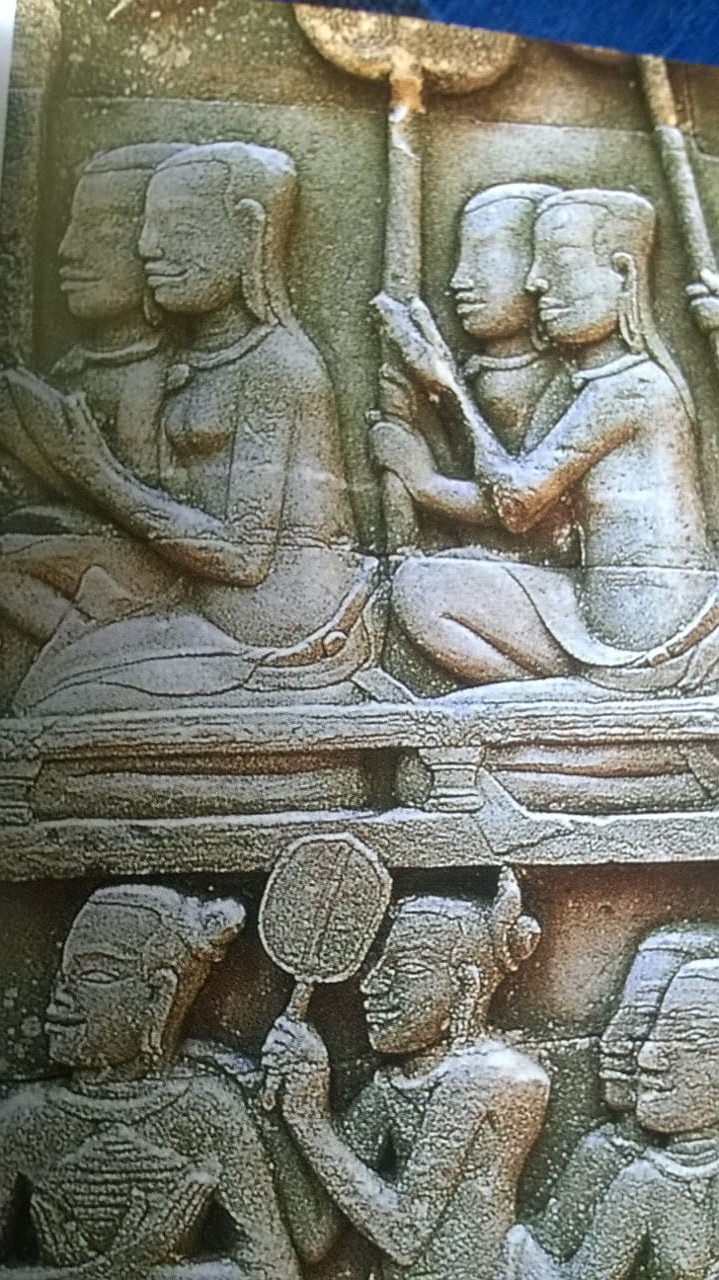
Sandstone offered a perfect canvas for chipping fine details. Running anecdotes from epics and mythologies, from Ramayana and Mahabharata, from heroic feats of lord Krishna to tug of war between Devas and Asuras in quest for Amrita ( the elixir of life) from ocean floor are brilliantly displayed in murals and bas reliefs. What fascinated me was the wonderful combination of painstaking labour and artistic vividness. They gave an immortal dimension to work of art in Angkor premises.

IMG_1158

The day was sultry. Tourists gathered and shutterbugs had a great time before sandstone carvings. Portraits of daily life was beautifully delivered with a focus on custom and culture. It was women who controlled trade in local market. More information came from visuals cut in rock. They ate sticky rice with fingers rinsing  from water filled bowl as was illustrated in embossment.

IMG-20180812-WA0005

Side by side with incomparable artistry, specimen of crude vandalism show their ugly faces here and there. Heads hacked off and chipped off faces of brilliantly done figurines exist, exposing our  sadistic side.Drawing pleasure knocking down cherubic sculptures  was a shocking contrast to beauties in stone that were left untouched.Was it a vent for releasing fury directed at someone ?

IMG-20180812-WA0007

Sometimes it is driven by  criminally gainful motive.  Entire statues weigh too much to be carried away by plunderers. Heads are broken off instead and sold fetching a handsome price. Headless busts stare in mute protest with a ghost like look. Theft of artefacts are not uncommon and crackdown effort on art nappers  is rather slow.

IMG-20180812-WA0008

Rigorous punishments should be imposed when caught.  But damage caused to sacred sites during civil war under Pol Pot regime were minimal . The armed troops must have revered the holy Angkor temples! The fringes of Angkor Wat is marked by a wide trench paved with laterite and sandstone. I feel the plan of site  was modeled  on Vaastu.
Subtle hints at every detail of exterior and interior decor is a study of imagery giving full expression to religious beliefs held.

I entered  Angkor Wat city from West crossing the causeway over  moat. The chief temple and the causeway were not from the same period. The latter was built more than a century later. Entrances are large enough to accommodate passage of elephants and chariots that had once crossed the moat over wooden bridges.  Structures were robust  enough to take on heavy traffic.

Towers of the temples offered majestic view. At sun set they glowed  a fiery red.
The handrails of the sidetrack were in the shape of Naga serpents. Lions and Nagas skirt the steps down from the sidetrack. These creatures must have been drawn from Hindu myths. Myths or no myths it is evident that forests close to Angkor sheltered large snakes as does the Lake Tonle Sap, a home to water snakes.

Primitive Cambodia must have been heavily forested even in the vicinity of temple premises. Encounter with monster snakes is quite likely. Fear has generated reverence. Reverence had beaten a cult to laud and worship the snake god.  The bas reliefs are debatably one of the most popular products of Khmer art.

IMG_1121

It was a long walk along the ruins and  I came upon a large carved area  that featured a plethora of artwork. The subject again was drawn from Hindu sources, the grand fables of Ramayana and Mahabharata. A section of the Western Gallery depicts the battle of Kurukhetra in Northern India, describing in detail the violent and climatic clash between nemesis clans of Pandavas and Kauravas as was told in Mahabharata.

It is dynamic and lively displaying marching troop leaders, horse drawn chariots and elephants, bands and cavalrymen all set toward some kind of finality. At the hub of the battle up close hand to hand fight is set in a portrait of random bloodshed. Reading the description in  book is one thing and exploring it live is entirely a different experience. Bas reliefs successfully presented the theme set in a grisly tableau.

All you need is travel in time machine and the picture in front comes live in flesh and blood. Silent scream from wounded soldiers strike a chord deep inside .You hear it and here lies the mastery of the bas relief artist. It is not the tools and gear that is important. The keen inner sense and driving creativity is what made the work classic.

Scenes from the  creation myth, Bhagavata – Purana, the churning of the sea of milk where Gods and Asuras battle it out pulling by turns  the body of Vasuki , the sea serpent was slightly defaced. Nevertheless it was riveting. Multiheaded Ravana holding in grip five heads of the giant serpent Vasuki heightened its oomph. A horde of Asuras struggled in a row with horses and elephants just prior to churning starts.

Angkor Wat 5

As I walked along the ruins, statues of a multitude of wild life, some real and some mythical came into view. It included a variety of aquatic creatures. Tourists busy spotting prized statuettes and monks in robes feeding pigeons echoed peace. Interesting moments awaited us. Solitary alms man holding out  charity bowl is a regular sight. How about a cobra coiled round his neck as well to complete the dramatic effect ? It  brought mixed feelings.

The final bas relief is a sensationally compelling portrayal of the epic Ramayana, the battle of Lanka. Scenes displayed strike a lively semblance with all what we had read in text. Lord Rama shooting demon Maricha disguised as fake deer opening up chance of Ravana’s abduction of Sita. Standard of sculpting is splendid and in Lanka battle   details of hand to hand combat is closely laid out.

Bow wielding Rama stands on the shoulder of mighty Hanuman. Next to Hanuman stands Rama’s brother Lakhsmana. Together with the trio stands demon Vibhisana, brother to Ravana. The story of Vibhisana’s desertion of Ravana’s camp resonates with treason. Defection to lineage of demons and teaming up with Rama and his allies doesn’t sketch a very favourable image of the turn coat.

Series of depictions of Lanka battle and its fate throw a spellbinding montage! The carvings look real  as if cluster of statues would spring back to life any moment. The spectacle is rip roaring and carvings in stone throbbing.

After Angkor Wat, I moved to Bayon temple or the temple of Buddha’s face. Temple architecture is complex and carvings on walls spectacular. Buddhist motifs featuring reclining Lord is terrific.  From Bayon went on foot to elephant terrace, taking leisurely stroll among trees planted along the bank of lake. Melodic twitter of birds and a mild breeze worked wonders to relax the mind. Except for a few aggressive monkeys busy with their business as usual, the place was otherwise restful.

IMG_1218

Lake Tonlesap seemed a coveted trip option. Took a cruise across the lake, sailing past the floating  village of Chong Kneas. This was a novel experience that ensures you can survive even without putting your foot on terra firma. A complete water world featuring everything from floating markets to floating   gas stations.  Vendors approached  with boatload of retail. Cigarettes,chocolates and flower bouquets all aligned in a neat stockpile.

Floating schools and paddocks from where fattened pigs peeped through a padding of blubber. Animals stared with a stoic indifference despite the irony that they would be served for dinner sooner or later. Floating bars , snack shops and memento corners  organized around a revenue earning drive. It was pure fun and the shinny spring sky added to the resplendence of the mood.

IMG_1152

Angkor Wat is a revelation. It is a perpetual study in marvel, something to ponder and much to wonder. It will take days and even months trying to understand the intricate designs and sculptures. And yet you feel you are back to square one. The shroud of enigma is too opaque to decode the secrets held.

The last bus to Siem Reap was scheduled to leave in an hour. The spires of the temple stood stark against a starry night sky. I bade farewell to this time honoured Hindu temple of UNESCO world heritage fame and occupied a window seat.

angkor-wat-1

Hollong – Exploring the wilderness


IMG_20171226_065722

Padatik express was scheduled to depart for NJP (New Jalpaiguri Station) at 10-45 at night. It was a cold and smoggy witching hour before Christmas. NJP was only a night’s journey but as you never know when this slowcoach will reach you to your destination, a worry gnawed inside me. Fear of vacation time being drastically cut for late arrival would be too much to swallow. The express train was shamelessly doing justice to its name Padatik (traveler on foot) with religious irregularity.

Jaldapara had been in my bucket list since ages and we booked our trip well in advance. Jungles have always been my favourite stopover in between backbreaking treadmill of life. This is a National Park in Northern part of West Bengal at the banks of river Torsa.

The name portrays a familiar picture:  tourists on elephant back stranded in a hair-raising showdown with an obstinate Indian one horned rhino about to charge! We set our foot in NJP around noon next day.

Locating our car to Holong Eco Resort was a delayed and frustrating exercise by itself followed by an exchange of phone calls and a string of silent cuss words. Car would take 4 hours and we were in no mood to starve. Cancelled our resort lunch booking and opted to have some grub en route. Bapi da’s cabin was driver’s recommendation. It was almost an hours’ drive after crossing Teesta barrage.

IMG-20171226-WA0007
The restaurant owner was a local celebrity, his team of culinary geniuses toiled day and night working miracle in the greasy and claustrophobic kitchen. We had rice and generous helpings of spicy lamb. Now that we were appeased, the long rough ride flanked by tea gardens on either side had stirred up our feelings. Holong showed up around 4-30.

Khairbari Leopard rehabilitation center was just cut out for an interesting exposure to wildlife habitat that I was looking for.  A fenced corridor was all that separated the wild cats from civilization, with enclosures covered in dense foliage. Khairbari was lot more than just a zoo. Thick forest thrived within the animal confines and on the outside too.

IMG_20171224_162604

Sun set viewing offered terrific photo opportunities and the place had a look of picnic spot in a wintry noon. The centre housed around 15 wild leopards and Bengal tigers. They were mostly rescued from the forests of Dooars and Bhutan foothills.

Two tigers were from Sunderbans. Injury and senile decay would have killed these beasts unless timely intervention by forest department proffered help. Some had been destined for lifelong banishment in circuses. Morbid glimpse into the depths of animal misery in circuses manifest the quality of life within painted tents. And before the trainer’s whip!  They have at last found a peaceful abode in Khairbari.

We walked along a long stretch of grassy pathway with an idyllic setting so far as eyesight would permit. It was a large circular track around, enclosing a menagerie at the center. Ample greenery somehow helped animals overcome the melancholy of habitat loss.

IMG_20171224_153147 - Copy

To our right flew the narrow sliver of ‘Buri Torsa’ river where occasional boating was allowed. On the left, lay feline enclosures. A creepy silence hung in the air. We walked for about two hundred meters before we could catch glimpse of a sleeping leopard. A little larger than a Doberman, but the size of paws made the difference!

We were outside the cage but not safe! Sign of rage was everywhere. An elephant had come out of the forest the previous night and had snapped overhanging twigs. A trail of destruction followed the animal’s footprints. A second assault would leave us with no other option but clamber the feline enclosure. Tigers weren’t visible possibly resting in shade of lair.

Tense moments passed and one of them stood up and made a stifled growl. It was a tigress that had suffered a recent miscarriage, we learnt. Dead cub foetus had been safely taken out by caesarean saving mother’s life. Deeper we went more desolate we felt. The nearest visitors to the centre were at least fifty meters from us.

We heard their voices, intensity of tone reduced by distance. Chance of second appearance of the mastodon clung to my mind with an icy cold dread. Evolution through ages might have shrunk their sizes but not the vicious instinct. We decided to retreat and made it fast.

Another tiger enclosure was only a few minutes walk from the entrance. We had missed it in a hurried curiosity to witness the aftermath of elephant  going manic. Nothing was visible; an empty piece of grassland lay across a moat. Tiger was certainly on the other side hiding somewhere. This side of the moat a five feet concrete wall ran close to the fence circling the entire enclosure.

Unsettlingly powerful, a stench hit us instantly with a scary apprehension that in absence of breeze how come the stink travel up to us from lair? A few minutes have passed when a massive shape of orange emerged from the moat. It’s rear side directly facing us. First the huge muzzle, the powerful shoulders, hindquarters and gradually the whole beast came into view.

IMG_20171224_155750

It had been very close to us cooling off in water that explained the overpowering stench. The animal had been blocked from vision by the skirt wall. This was a large tiger. Sun threw long silhouette of the animal on grassland. The setting sun in the background blended with an uncanny threatening snarl building up the atmosphere. The beast was probably hungry.  We backed out and boarded the car after a few quick camera shots. Destination was the Hollong Eco Village resort.

Khairbari rescue centre is a constructive endeavour, nursing back infirmed large cats to health and happiness. Illegal poaching is yet another plight through which wildlife population is going.  It’s hard for forest officials to fix an overnight solution to the issue. Gradually, things are looking up. Let’s see how everything pans out for future.

20171225_073453

We reached resort within an hour and the staff organized refreshments and mild hot tea. Without much preamble we reached important points quickly straight after tea; discussed itinerary, local interests and the safari at Jaldapara wildlife sanctuary.

Resort management promised every support but flatly refused offering any help in the safari and getting tickets. We have to do it all by ourselves. This was an unpleasant surprise. The tour agent had promised otherwise. Was it a kind of tourist trap now that we have been in their grip? They were trying to pull wool over our eyes to squeeze some extra buck !

Dinner at the resort was good. Chicken, chapattis and Dal and before that authorities had arranged a small bonfire in the front yard and a huge Christmas cake adding to the charm of a typical Christmas night . The fire had comforted us against shivering cold but the uncertainty of safari gave us niggling discomfort.

IMG_20171225_084906

The resort is in the lap of nature. You cross the boundary fence you are inside dense jungle. We would explore it and the surroundings first thing tomorrow at the break of dawn. Early next morning, it was bone chillingly cold. We put on jumpers and walked towards the jungle that had commenced from the edge of resort boundary.

Once inside the forest, it was mute and peaceful. Broad-leafed evergreens grew rife. The soft sunlight had burned away the pre dawn moisture exposing a colossal quiet domain where boondocks ruled. Unknown species of orchids and creepers hung intertwined.

IMG-20180408-WA0004

At ground level vegetation, grew up to man height that trapped low ground fog. We went further deep and were completely mesmerized by the beauty creation had bestowed upon nature shrouding it with mystery. We had been travelling on foot all the way and had to be careful stumbling on fallen sprigs and slippery earth.

IMG-20180408-WA0002

A stream flowed by. The water was cold and crystal showing pebbles and strands of vegetation washed down from the distant hills. We made good use of soft light and the lens. It was breath-taking and packed with thrill .Sight of mounds of elephant droppings alarmed us. They came over so close to resort in a feeding frenzy. Further venture would be risky! These are wild rogues. They won’t deliver any benefit to us. We retreated back and reached the resort by 7 am.

IMG_20171225_082723

My video shoot continued capturing many other interesting elements. Next morning, at the breakfast table, the resort owner enquired about my video shoots. Suspicion in eyes reflected inner guilt. His attitude last night had been a little rude on safari issue. News of my working for the media sort of straightened up things for us.

Things worked at an enthused pace. Process of garbage disposal sped up.  Behavior of staff had turned courteous. Food was served with extra care. It wasn’t surprising when some extra plates of meat went wandering around tables before being set before us. We modestly refused any favor not paid for.

At times you need to hammer the nails in place. Needless to say, soon came the obvious concurrence to take care of our safari with all official formalities. It was worded by the owner with firm commitment. What the resort lacked in its primary dealing with customer was later ponied up by outstanding service.

Safari booking office at Holong was crawling with tourists. We reached here soon after breakfast. Two trips were made in a day for duration of 2 hours each. Early morning 5-7 am trip was in great demand. Chance of wildlife viewing was high. Evening trip from 3-30 to 5-30 pm pulled less crowd.

Tickets were available for evening trip, but dawn safari would be booked out shortly after the ticket counter opens. We opted for the dawn trip and that was possible only the next morning.  Ticket counter would open at 6 pm. We had adequate time and our cab driver fixed a local guy on tips to get a proxy for us in booking queue.  Meanwhile, we could make a quick trip to Phuentsholing, the first town crossing the international border into Bhutan.

Road to Phuentsoling snaked along the outer realm of eastern Himalayas. We drove past a Bazar crowded with locals and shops. Liquor shops were rampant. Merchandise ranged from slices of pork to tiny replicas of Buddha. As we rode higher up the mercury started dropping. On the way lay a crocodile farm. Long snouted Gharials and salt water crocks lay in sun. They were well fed and big.

20171225_114809

Phuentsoling Monastery was an ornate cluster of stupas and structures that evoked faith. Prayer flags flapped in gentle breeze setting up a silent communion with the celestial. Buddhism is the primary religion in Bhutan. An element of devotion prevailed. We tossed around enormous brass prayer wheels of the Monastery murmuring our desires with intense mindfulness.

IMG_20171225_122052

Phuentsoling was done. We drove back to Jaldapara safari booking counter around 3 in the afternoon followed by a long wait. Elephant safari was out of question. It is reserved for those put up in Holong guesthouse. We battled for the gypsy safari.

The much awaited Holong Safari !

Ticket counter opened sharp at 6 in the evening and what initially followed was bedlam until a couple of local goons enforced order in the queue. Tickets procured and we retired early keeping in mind the next day’s morning safari commenced at 5 am.

26th  December. It was still dark and nipping cold. My watch read 4-30 a.m. We prepared hurriedly in the freezing dusk groping our way to the resort restaurant. Hot tea laced with a dash of ginger early dawn was invigorating.

IMG_20171226_064546

Resort car arrived and it reached us to an open ground adjacent to the safari booking counter. Rows of gypsies were parked and from here safari would start. Located our vehicle by the number printed on tickets and sat inside. Safari guide and rest of the family occupied rear end. It was still dark when the vehicles entered the forest in a close convoy.

IMG_20171226_065701

A bitumen road was cut right through the sanctuary and our vehicle sped along.  Huge trees grew on both sides. The jungle was inky green. The sky had started to clear and a faint pink impression announced day break. The light was tender and not enough for  clear visibility . Vehicle’s headlights shot a pair of strong glimmer. Birds chirped and the morning chill clung like icy sheets.

Thick bushes were ubiquitous and a shallow ravine was bridged by a collapsed deciduous tree. Could be work of unauthorized lumbering. Timber smugglers sometimes sneak into the forest evaluating and exploiting commercial opportunities.

Clashes and conflicts with forest guards do happen. Chances of collusion with forest staff cannot be ruled out opening up lucrative contacts with forest wealth that they don’t hesitate to amass. But this one looked like it had been struck by thunder.

The forest had a mixed floral character. Savannah land and tall elephant grasses occupied a substantial area. Tall forest included teak, Sal, shishu and many others which I could not identify.

IMG_20171226_064802

The vehicle abruptly halted when the guide threw a powerful beam from torch to our right. Almost sunk in neck deep vegetation, a hog deer silently fed on succulent grass. We paused for a minute or two and proceeded forward. Soft morning light lit up the surrounding herbages.

After about a quarter of an hours’ ride we met the first rhinoceros. It was quietly feeding and was set alert upon our arrival. Quite surprisingly, despite its bulk a rhino can break into an explosive run. Their stealth is prodigious and rhinos are competent of exceptional brutality. Over courtship rights males fight each other inflicting deep lacerating wounds.

IMG_20171226_060141

Only a few months back a forest officer was found in the bush. Body showed deep injuries. Nature of wounds point a finger towards a rhino attack! The large animal looked like an army tank. It emerged from the forest, crossed the bitumen road and melted into the thick shrubbery on the other side. Adrenaline rush was peaking and we parked in an open area beside which stood an animal observation tower.

Close by, an elephant was tied to a stout tree trunk. The animal belonged to the forest department.  It had recently turned rogue killing two Mahouts. It was going through a punishment session being fed lesser ration of fodder.  Wonder if jungle crew are secured by insurance cover. Insulation against these casualties is imperative if not already available to the family of the deceased.

IMG-20180113-WA0004

Climbed the watchtower. Vast stretches of grassland with occasional overgrowth of plants spread out so far as vision could take us. Panorama was breath-taking and the faraway hills offered a spectacular backdrop.

Grazing rhinos at a distance brought some excitement. Tourists on the watchtower tried to zoom in the animals to focus. It was amusing to watch these creatures. They wore a prehistoric look and were engaged in a playful squabble.

A sudden yell had broken my trance. A herd of wild elephants had been sighted within a kilometer. We rushed to the spot and saw the herd from a distance of 25 meters. The bull was shoulder deep in grass and possibly furious with our intrusion. We were lucky that a huge fallen teak wood trunk was in its line of attack blocking any further advancement towards us.

IMG_20171226_060955

We realized, despite its bulk how skulking an elephant could be. In most of the cases, the target becomes aware of its presence just before the enormous mass pounds on him.  The victim generally doesn’t survive to narrate his experience. My watch showed 6-45 am. Safari was coming to an end. Our vehicle raced for the sanctuary’s exit gate with a troop  of macaques chasing us with mischievous intent.


IMG_20171226_062947

Captivating Coorg

DSC00249

Welcome drink of ginger wine was only a faint hint at the warmth  of hospitality coming our way from  Prasad family, the owners of coffee garden homestay, a breath-takingly quaint abode set amid lush coffee plantations of Coorg, in Southern Karnataka.

DSC00401

Spread over a sprawling estate the living quarters featured a lot of greenery, an open front yard for drying ripe coffee beans after harvest and a large backyard allotted to organic farming of vegetables. A deep pond lay close by from where irrigation water was sourced.

A pack of guard dogs ensured security to the master,as did a skein of ducks, no less threatening than the dogs themselves. The birds would charge trespassers to the estate with a shared fury – a show of loyalty to the estate owner. Heads pointed low in a stubborn threat and a high pitched chuckle would make strangers run to avoid an assault .

We started the night before from Karwar, a sea side picturesque town known for exquisite beaches, the distant Western Ghat mountains and a lot of fresh catch of marine fauna ready for the market. It was an overnight journey to Mangalore, where we boarded another bus to Madikeri , a hill station not far from Coorg , the principle coffee belt of India.

It was spring and the forest was in full bloom. Its indigenous  vegetation included a wide array of familiar trees and some were completely new to us. Teak , Sal , Panas( a type of jackfruit, the leaves shredded around midriff) , beetle nuts and a lot more. Among outlandish varieties,  rubber , cardamom, black pepper and vanilla were the ones on which I set my eyes for the first time.

DSC00398

This part of the country is quite unfamiliar save for a knowledge that people are hospitable and brave. They contribute a substantial support to the country’s armed forces. Soft rays of the early morning sun shot through drifting smudge of clouds and the foliage high up.

The green canopy had started to thin out pouring a shower of old leaves. Fresh new sprouts replaced them heralding the onset of Spring. It was mid February  and nature started to look up bright and blooming. We reached Madikeri, the nearest outpost to Coorg coffee plantations by 10 in the morning .

This was a place of rain forests receiving a heavy spell of annual showers . We took a cab to the homestay located  in the middle of coffee farm. Half an hour’s drive and we were in the Estate. The cottage was impressive, the interiors well furnished. In consultation with our hosts we drew up our travel plans.

It was a brief three days vacation with an intent to cover as much ground as feasible. First day would be spent in Dubare Elephant Camp and Tibetan Monastery at Bylakuppe, ending the days trip with the sunset viewing over river Tala Cauveri and Raja’s seat.
The second day was to be completely devoted to Iruppu waterfalls and Nagarhole wildlife sanctuary.

Mr and Mrs Prasad were a wonderful host. Days were spent in sightseeing and nights over rounds of coffee with interesting conversation on subtle crafts of coffee farming, local culture and places of interest.

We were served the local cuisine where pork formed the principal meat. A second meat that was popular was lamb. In fact the number of pig butcheries’ in Coorg reminded me of pork stalls set along Guwahati – Shillong road.

Our first stop was Dubare . Drive was along a stretch of silt strewn with boulders, undulations and dense woods closing in on either side. It was a reserve forest known for spectacular range of avian fauna. An elephant ride point and training camp on the banks of river Cauvery had made this place a popular tourist haunt.

imageedit_4_4931128546

Unfortunately the giant pachyderms’ were out on business carrying tourists atop their backs. Huge mounds of poop marked a trail of  movement and were finally lost behind rock and bush.  Angling buffs focused efforts on harvest from the river. Mahaseer is found in plenty .

They are big and tasty and prized throughout the region. License from Coorg wildlife association is mandatory for fishing in Cauvery. Limited time frame and tight budget  kept us away from the tempting opportunity for water rafting.

imageedit_4_8246724341

Cauvery Nishargadhama was our next stop. It was an amazing place to visit especially those with kids. We had our 6 year old with us . He was bubbling with enthusiasm and there were  strong reasons for him to be jumpy and frolicking with fun. The place was predominantly occupied by bamboo grove.

DSC00276

Enclosed within, were separate enclosures for deer , rabbit and peacock parks. What we couldn’t get in Dubare was achieved here. We had an elephant ride though the span was only for a short 10  minutes covering about 400  meters of parkland. A lake was cut across the park through center and a bridge hung over it running end to end.

DSC00282

Half an hours’ boating at the lake was an amusing  experience.Water was far from crystal clear and mostly covered with floating reeds. We felt hungry and exhausted from boating but our flesh and mind was pepped up craving for more.

DSC00268

Next destination was Namdroling Tibetan Monastery at Bylakuppe that took around one hour ride along fast roads with a splendid backdrop. The abrupt and dramatic presence of stubby coffee bushes and sight of tall trees interlaced with pepper vines was jaw dropping.

DSC00294

The  monastery has an imposing structure. This place is the second largest settlement of Tibetans in India after Dharamsala. The temple complex is immense with a  40 feet high gilded statues of Buddha Sakyamuni and Guru Rinpoche. Temple tower is richly decorated and walls are painted with elaborate murals taken from Jataka lore.

DSC00304
DSC00297

Depictions of  Deities and Demons  from Tibetan mythology added to the temple frippery. Here we relished vegetarian lunch , hot and fresh and insanely tasty. At the outskirts of the monastery we encountered rhesus macaques. Deceitfully harmless the harlequin in these cart-wheeling primates is too dangerous to be funny. A large portion of their thought process is committed to shenanigans. We warily avoided the troop keeping safe distance.

The sun had now inclined to the West and the temperature dropped by a few degrees Celsius.  Wrapped in light woolens we moved ahead in the direction of Raja’s seat , the point from where some amazing sunset viewing was guaranteed.

The seat is perched on an elevated platform from where the evening sky looked surreal. The sun was a massive burning ball and had shot in its fury, the color of fire. It was doozy, holding a kind of rendezvous between us and the divine.

DSC00392

Mellow rays of the setting sun had drenched the cliffs and valleys in fiery red clearly explaining the reason for this being a favorite haunt for kings of Coorg. We reached homestay late that night and were treated to a sumptuous dinner of ghee rice and lamb curry , rounding up with some yummy home made desserts.

Post dinner conversation break with the hosts and other guests was concise as we called it a day to an amazing evening. Excitement of visiting the Nagarhole national park next day was blinking inside us. Next morning, the second day of our Coorg vacation, we started early, our first destination being the Irupu Falls.

DSC00323

We parked our car half a kilometre away from the cascading falls and continued on foot. The place was all immaculate beauty with rocks , boulders and thriving greenery being the primary elements, needs of civilization were secondary.

Nature has sculpted the place  with a creative zeal and what has come up was of incomparable artistry. Steps ran up to the source of the waterfalls. It was quite a trek, climbing around 130 rocky steps slippery from moss.

DSC00325

The  environment was too scenic to be captured within the limits of a 5*3 digital screen. As we approached the source, thunderous rattle was deafening. Having spent some time up there, we managed to capture some dimmed yet wonderful moments through our lens and started on downhill trek. Needless to say, that trek left us very hungry.

DSC00334

Lunch was simple and quick, keeping in mind Nagarhole visit. Rushed towards Nagarhole, driving past enchanting scenery of rivers, streams, green dales, hills and forests. The cabbie took off at full throttle as he dragged hard on his cigar.

We reached the Nagarhole entrance around 11 am.  The path into backwoods was edged out with tall trees. Beyond the first line of trees lay open grassy plains that was again fringed by a second layer of vegetation. This was thicker and possibly sheltered wildlife.  One could smell thrill in the air with all eyes narrowed and focused on dense undergrowth to catch a glimpse of our evasive wild hosts.

DSC00387

Our ride wasn’t allowed beyond a point blocked by a gate barrier. We walked up about fifty meters to a ticket counter for boarding safari bus. Booking counter was shut and it was a long wait on a sun drenched spacious ground covered with trimmed grass. The counter opened shortly to a rush for tickets.

Ride started and bus moved deeper into the jungle. 15 minutes have passed and a herd of chitals came into view. They were busy feeding,unmindful of the tourists. This was a sanctuary  not to expect threat from visitors. Bus stopped and cameras clicked.

DSC00376
DSC00375

Trees were huge and creepers ran up clinging to the thick trunks.Grey langurs in large tribes swung  in boughs. You like or not Langurs are in abundance and you fail to spot your favourite animal in the wild despite your best efforts and expectations. A bad stroke of luck is your  companion.

Forest cover grew tightly packed and a sodden bed of rotting leaves and stumps of fallen trees made the ground squishy. Decaying fronds collected on the forest floor had an overgrowth of mushrooms and moss. On the putrid twigs and slippery foliage fresh dry leaves dropped  setting up an eternal cycle of ecosystem monitored by nature.

DSC00385

As we traveled further, dense woodlands had receded to a scanty chaparral. We stopped by a lake, its water green from algae. Sight we expected the least was of three tortoises cuddled peacefully around a dead tree stub partly submerged in water.

DSC00388

A philharmonic of melody around us sounded exotic. Warble of birds,ceaseless chirp of crickets and screeching of macaques had set up a jungle symphony that wasn’t too bad on our ears. The bus moved ahead occasionally stopping at breath taking landscapes for photo session.

We rode past a compressed growth of bamboo orchard and the green lake came into view again. Far in the distance at the bank of the lake stood a lone tusker. Bus stopped and shutters clicked. The elephant was  frozen in time like a despotic monarch caring a fig for  bus load of tourists. Only a stroke of luck can give you a glimpse of a tiger in an Indian jungle and Nagarhole was no exception. Nevertheless, the ride couldn’t be more exciting.

DSC00378

DSC00382
Pristine nature was a welcome break from bustling city life. By the time our Nagarhole trip was over it was 4-15 in the evening. We were back to the homestay after sun down. Our hosts had cooked pulav with a lot of garnishing and vegetable side dishes. Home made sweets were a hell of a treat ! Next morning was programmed to show us the coffee plantation before departure. Estate owner had promised to drop us at Madikeri in his jeep.

The day of departure was no different, being misty as usual. A little later fog cleared and sunlight beamed in. Our guide to the plantation was a lad Ganesh, the garden supervisor. And along came one of those guard dogs . We froze in place but Ganesh assured us of no threat patting the dog gently.

Plantation was up on a slightly higher terrain flanking the homestay resort backyard. Coorg coffee is excellent in taste . It is mild and grows in shade of Rosewood, wild fig and panas trees. The trees keep soil intact and anchored firm, setting up the nitrogen cycle as well.

DSC00418
DSC00414

The atmosphere was laden with a very pleasant fragrance given off by white coffee flowers that blossom in February. November is the plucking season when ripe red beans are harvested for drying. “The basic strains are Arabica and Robusta ” the supervisor rode  on a lengthy sermon finding his comfort zone in technicalities of coffee farming, its history, prospects and current issues.

For an honest opinion I was  more engrossed with wonderful vista around me. The sweet fragrance was everywhere. Not only the coffee blossoms, it could be the vanilla too, contributing towards a feel good ambiance.

We finished our round of plantation trip hastily, keeping in mind Mangalore bound bus from Madikeri left at 11. After a reluctant farewell we sped towards the Madikeri bus terminus putting as much miles as possible between the estate and our speeding jeep.

Hadrian Villa – An amazing exploration to Olive Oil culture


IMG_3113

One of the most famous Greek myths is about how Athens got its name. The miniscule population of this prosperous city in Greece was given the choice of being dedicated to either Athena, the goddess of warfare and wisdom, or her uncle Poseidon, the god of the sea. Each deity had gifts to beguile the innocuous citizens with, Poseidon assuring the city with no cases of drought while Athena planted a seed that grew into the olive tree that people around the world have come to know and love. It is obvious who became the well deserved patron, or rather patroness of this city and it can be safely said that if those clever Athenians did not exist a lot of our industries would not be so efficient at money-making. Indeed olives are an integral part of millions of lifestyles, whether it be for beauty or cooking.


Olives are grown in scores of places around the world with global farming industries in places like Italy and Greece. Tuscany, one of the largest and most renowned region in Italy is known for its fertile soil and the quality of oil in areas like Tivoli, a town overlooking the Roman Campagna in central Italy. In Roman times, the extra virgin olive oil made from pressing whole olives was called “Oleum Tibertinum” (Tibur being modern-day Tivoli) and Pliny and Varro lauded this beautiful landscape so highly that it was here Emperor Hadrian decided to build his architecturally pleasing retreat from Rome in 200 AD. This ancient tradition of cultivating olives was based on the mild climate and the slopes covered in volcanic soil, producing the Terre Tiburtine oil of the most globally recognised produce of all time.
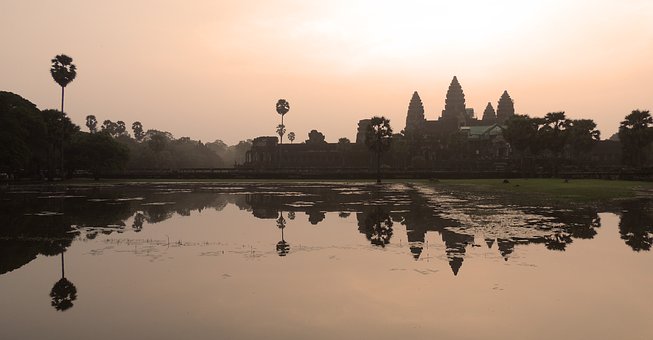
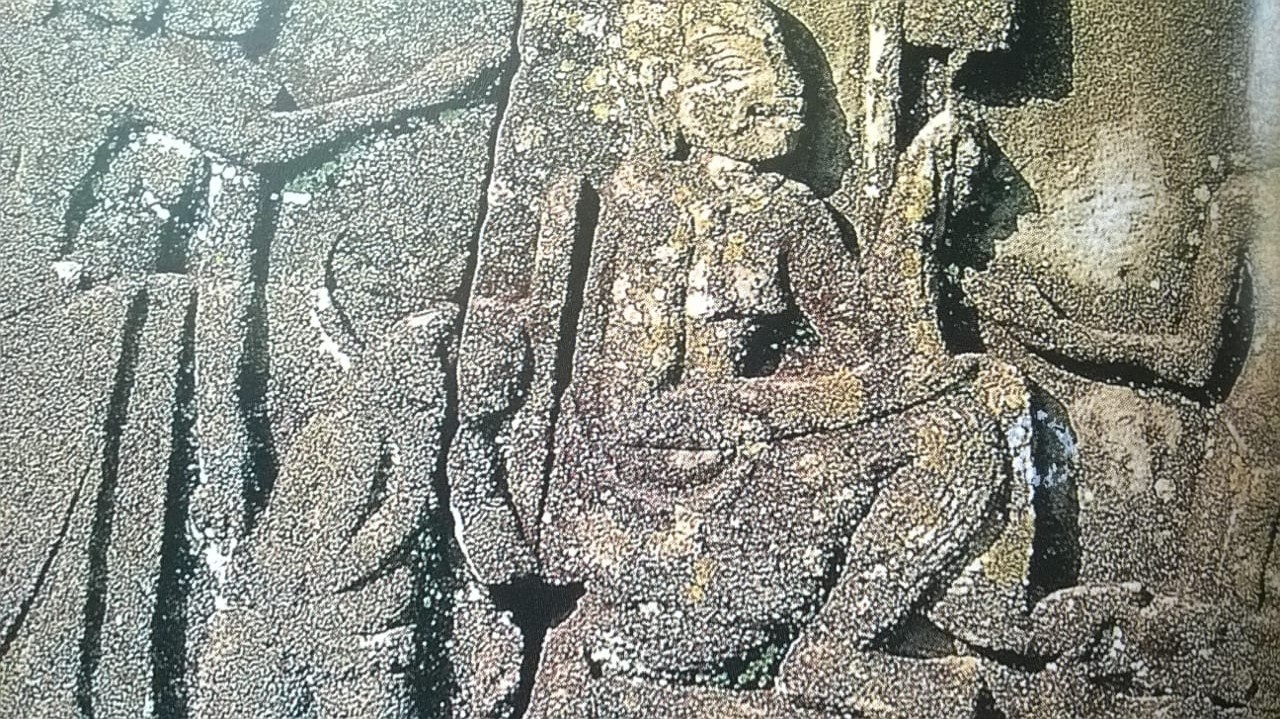
IMG_3134

Hadrian’s villa is a large complex structure, comprising the Serapeum (a temple dedicated to the god Serapis), the Maritime theatre, baths, pools, bedrooms, dining rooms, guest rooms and the servants’ quarters. This was cleverly divided into the open plans for summer and the closed rooms for winter. In fact, Hadrian went to great lengths to preserve the idyllic nature of the villa, by creating a network of subterraneous tunnels for the servants to continue to work.
 

Emperor Hadrian was otherwise known as the last minute emperor due to the fact that he was proclaimed heir to the empire at the very deathbed of his adoptive father and rightly so for he was the third of the mere five good emperors of the Roman empire. He was described as the most versatile of all Roman emperors, patronising the arts by demonstrating his knowledge of all intellectual and artistic fields. In fact, Hadrian’s Villa was known as the finest Roman specimen of an Alexandrian garden. The various Greek architecture is said to have inspired the Italian Renaissance artists as well, and it was here that one of the biggest olive oil-producing industries had started. As probably already surmised, Hadrian was very popular amongst his subjects and especially the slaves since he was once a slave too and so he took it upon himself to ensure that no other slave would have to face what he did.

IMG_3142

At his humongous villa, every slave had a home and wage amidst the breathtaking rural scenery of Tivoli in return for tending to the emperor and villa’s needs and working in the then newfound olive oil industry.

IMG_3140