
World’s largest mangrove swamp fostering eco-tourism
The early January morning threw a chilled blanket around us and the cab sped past towering skyscrapers along a maze of flyovers. We drove towards Kolkata Science City. The destination was the Sunderbans, a spread of mangrove jungle crisscrossed by a network of rivers and estuaries. Bidya, Sibsha, Matla , Koyra, Horinbhanga, there are several of them connected to nameless creeks and canals running deeper into wilderness. The names have a different kind of flavor, appealing and romantic yet menacing and deceptive.
The luxury volvo ride took three hours that whizzed past in excitement of anticipated dare that would follow next and continue for a couple of days. Godkhali was where we were to board a motor launch. Rest of our itinerary would be along waterways no chance of motor and bus rides ahead.
The marshy hinterland is far too inhospitable to accommodate those luxuries. In Sunderbans, you travel across water in fact you are not allowed on land except for a few designated areas approved by the forest department. It is no place to organize a picnic. Life and death balances on a fine thread. You will never have a chance to realize what pulled the thread.
Godkhali waterfront was old fangled. Worn out steps led to a frail wharf to which a motor launch was fastened. Chug of the launch had been with us for an hour. It had set up a nonstop thrum. We left Godkhali far behind. The villages have disappeared.
No more mud barrages and riverside rural markets where traders ballyhooed their stock in trade. A stretch of greenery replaced them instead. There were hardly any majestic trees so far visibility took us ahead, it was all man height vegetation around apparently harmless and peaceful.
Blue water looked clean river Duggaduani flew down South lined with trees on either banks. The trip organizers served us tender coconut water. You can throw away the empty shell into water but not the synthetic sipping straw, a wonderful effort to inspire green tourism. It was around 1-30 pm and lunch was served on deck; fish and rice with some veggie side dish.
The meal tasted awesome and the saline environment of the Sunderbans felt even better. The depth of jungle took a dramatic twist as rays of the sun grew milder. The sun was now on its downward trip heading for the western horizon. It was 4-30. The river that lay in wait in front was Gomor. What a pleasant name!
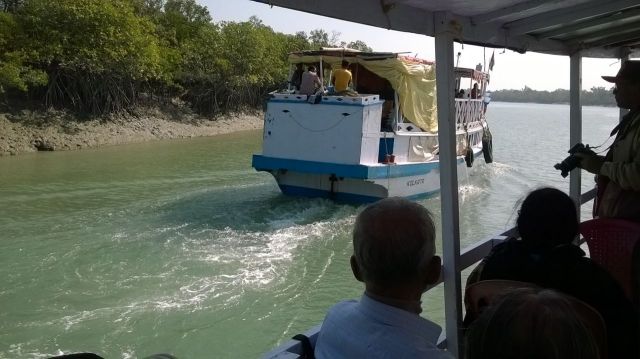
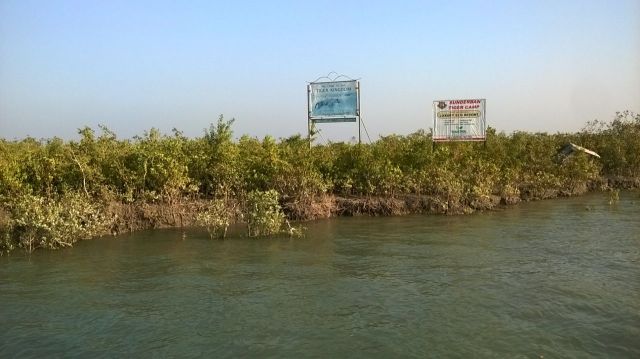
Brackish water broke against our speeding motor launch. The forest on either bank had changed character. They somehow looked unreliable. You cannot trust the calm it felt far too silent not even a bird was chirping and no sign of life; neither on bank nor on trees. The edge of the forest was fenced off from the river by a network that ran along the river bank as if in an effort to block movement from the forest into the river. Was the fence robust enough?
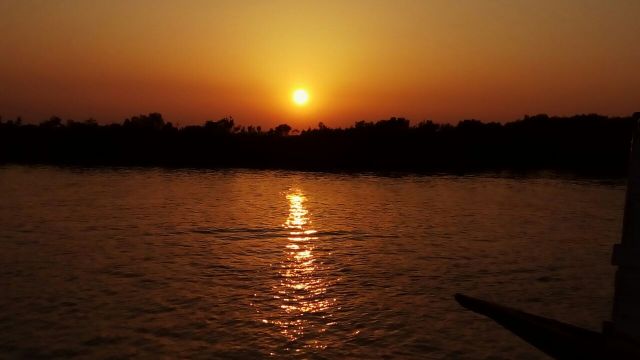 Sunset was beautiful. It painted the sky in myriad shades. Dusk was rushing in and the temperature shrunk around 11 degrees Celsius. Occasional Bangladeshi trading barges sailed past our motor vessel which bobbed up and down riding on the crest of waves.
Dulki – Exemplifying green-tourism:
Stepping into the Dulki eco-resort in pitch darkness gave a sort of strange kind of feeling. Dulki is a solitary village in the fringes of Sunderbans not far from Sudhanyakhali camp. But the resort presented a classical example of green tourism.
Nice little huts organized neatly along pristine greenery had a surprising comfort level to gratify tourists in this remote corner. Dulki, as the name suggests had swaggering milieu with an element of laid back rhythm that was pampering. There was a nice organic garden with blooming flowers. Organic vegetables looked succulent and straight ended up in the kitchen for guests.
![IMG-20170108-WA0026[2]](https://simplyroam.travel.blog/wp-content/uploads/2019/08/93305-img-20170108-wa00262.jpg?w=640) Local folk music and short plays based on regional lore kept us high and happy in the freezing January night. Dinner was great especially the spicy crab preparations were lip smackers. Dulki tourist resort was cozy and eco-friendly.
Local folk music and short plays based on regional lore kept us high and happy in the freezing January night. Dinner was great especially the spicy crab preparations were lip smackers. Dulki tourist resort was cozy and eco-friendly.
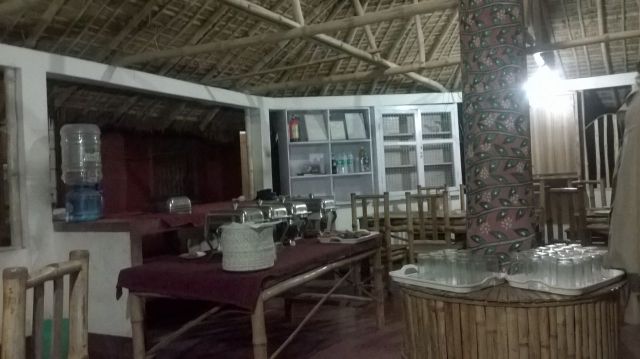
Next morning, the breakfast was hearty. Poached eggs with the sunny side up and unbuttered toast, sugared tea and a slice of orange were the right mix needed to load us up for the morning’s expedition.
At the entry point to the resort, a man was vending his saleable stock collected locally and from jungle. Bottled honey and Khejur Rosh (fresh date palm juice). Khejur rosh was rejuvenating and the honey probably carried gruesome history of generations of honey collectors lost in the forest. Our launch was tied to a pole at the landing. We boarded it carefully balancing on a shaft that led us up from ground to the deck.
Cruise through Peerkhali and Gazikhali creeks was marked by sinister silence. The dense forest lay on either bank. The navigator dared not take the vessel too close to the bank. Thin and dry rivulets ran deeper and disappeared into forest. An estuarine crocodile was basking in the sun. It slipped into the creek as we sailed past the reptile.
The mud flats along the river were studded with pointy-headed Pneumatophores. Specific trees are typical to the region. Sundari,possur, goran, keora, hogla, hetal and Golpata fronds. How wonderful these names have been. They carried a local essence with the possibility of death stalking behind every stand of bush!
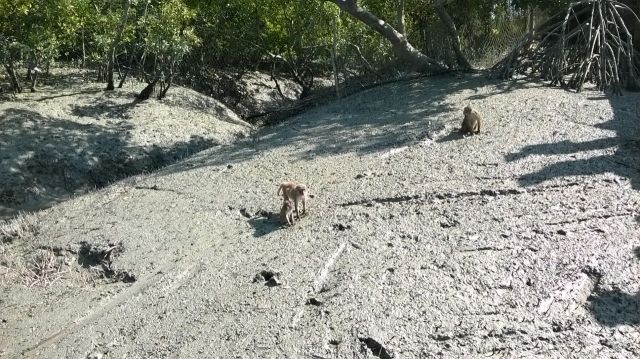
As our launch cut across the river at Sajnekhali camp, several rhesus monkeys drew attention. They were after crabs and river mollusks. There is always a code to follow even here far from civilization. An understanding exists between monkeys and chital deer.
![IMG-20170402-WA0006[1]](https://simplyroam.travel.blog/wp-content/uploads/2019/08/79cca-img-20170402-wa00061.jpg?w=640)
Keora leaves are a deer’s favorite. Monkeys throw them down and feed the herd at the same time warn them of impending peril. Nothing comes for free. In exchange for fodder and early warning signals they get a deer back joy ride often.
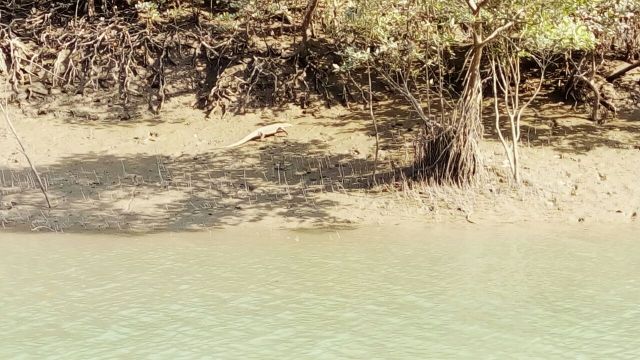
We saw more animals. A couple of monitor lizards laid rock still on the river bank perfectly camouflaged against a grey-green backdrop. There were egrets and kingfishers, water herons and jungle fowls.
The guide recalled chilling experience from the past on his way to Dobaanki camp. Incidentally, we were exactly on the same route. “The tiger”, he said flatly” is a master in the art of deception. He will play hide and seek with you. Never ever underestimate its cognitive sleight”.
He pointed out at a faded red cloth tied up to a Keora tree on the bank. It is exactly here we lost one of our mates last year. The moment you lose your alertness you lose someone overboard; just a few drops of blood on deck and a commotion in waters it is over and out. Only the eerie forest stands a witness to a well thought out hunting scheme designed by the elusive beast.” Having his words finished, he stared blankly at the distant horizon.
The swamp tigers of Sunderbans are a terrifying combination of ferocity, cunning, power and patience. He is a stealth predator. He will reserve all his patience and explosive assault to meet his objective until the right moment comes. When he is 100 % confident he is gonna make it, he strikes. Till then the king of swamps stays calm but watchful.
Even when you meet head on he will pretend he didn’t notice you. The canines have an awesome bone crushing bite force of 1100 psi. A forepaw swipe can break a wild boar backbone. He is an efficient killing machine perfecting the art of hunting to surprising precision. So aggressive that he will not hesitate to brave waters in cold nights, swim aboard and take off with a prey.
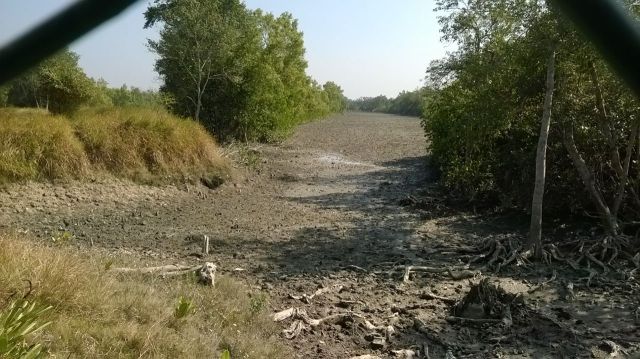
Dobaanki tiger camp was a slight departure from Sajnekhali and Sudhanyakhali camps. It allowed us a thrilling cage walk within the safety of strong wire mesh running about a kilometer inside the forest. Sweet water ponds were cut into mud.
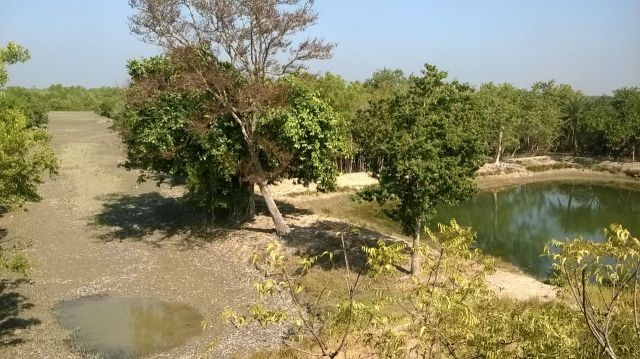
Large sections of jungles have been cleared to allow chance visibility of animals on prowl. It was here where a swarm of bees appeared out of the blue. We ducked and stayed in place letting the swarm pass peacefully.
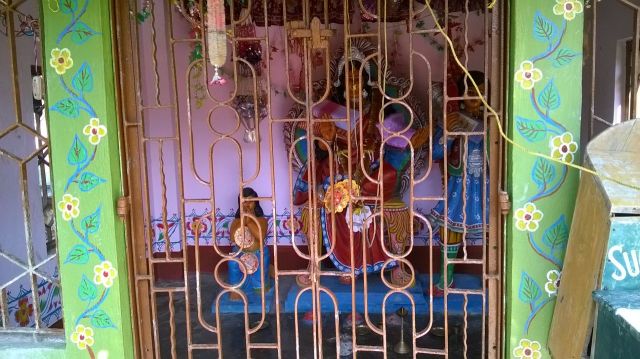
There is a Bonbibi temple at Dobaanki camp. She is revered by all irrespective of community. People here live below poverty line. Jungle wealth naturally lure them. They need to go into the forest risking life in quest for wood, wild honey, crabs and fish. Before they do that a ritual is offered before Bonbibi for protection against the tiger. Sometimes they win and return to the safety of home. Sometimes they lose. It is customary to tie up a cloth to a tree at the spot where the kill has been made.
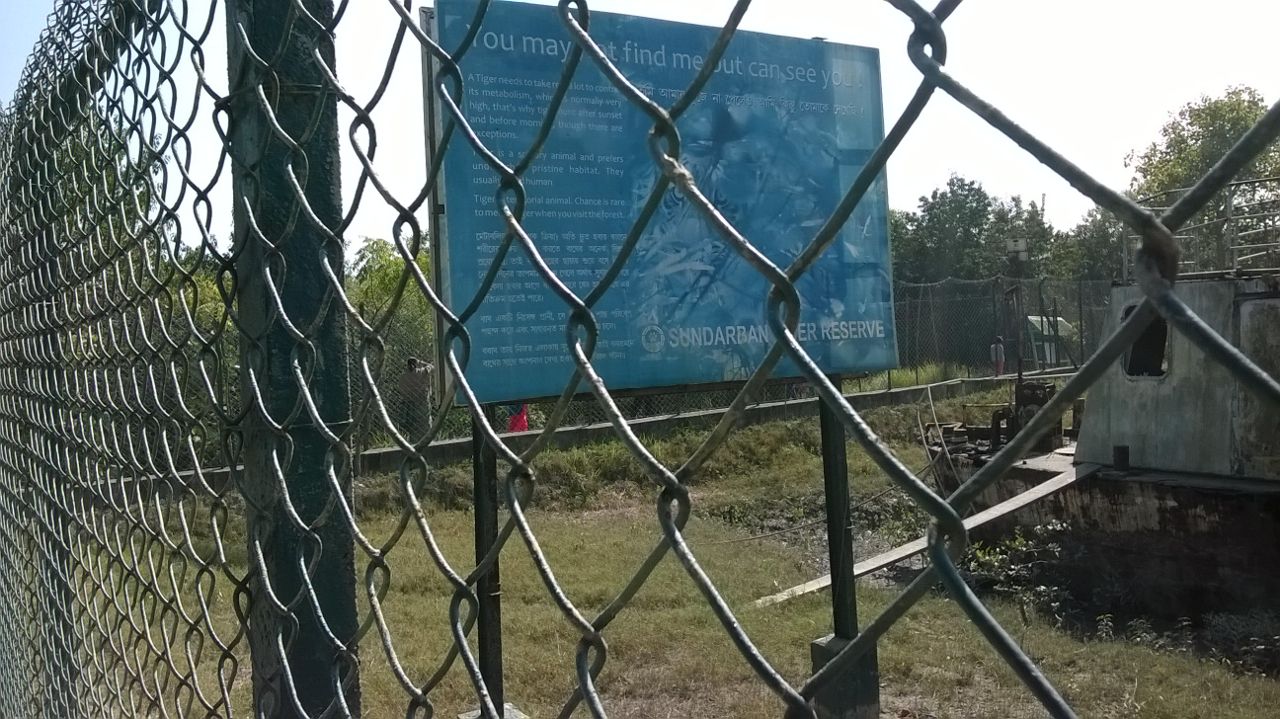
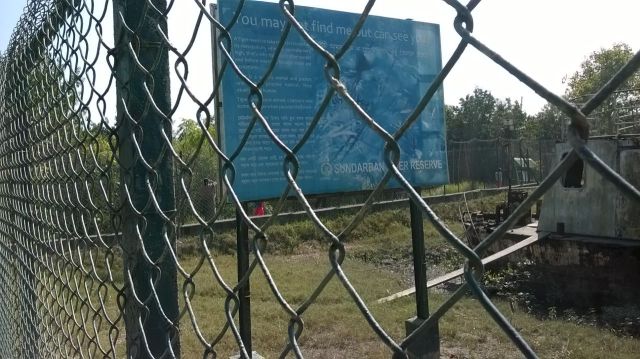
The fencing around Dobaanki was hardly 6 meters high. Is it insurmountable? “The beast is better at broad jump than at high jump”, the guide broke into a smile reading my mind. “Sir you see there isn’t much scope for broad jump. The place is a bed of man height shrubbery”. The guy has logic in what he says.
There was a wreck of old remains of a rusted ship salvaged from the river. Could it belong to Arakanese sea pirates? Once the marauding Maugs from the Arakans had been very active over here. However, this time there was no one to answer my query. Old temples and deserted old buildings still exist amid wild vegetation. Civilization existed here long back, perhaps now they are all tigers’ den.
Having finished Dobaanki trip, it was time to return to our green tourism nook, the Dulki resort. The sun set wasn’t far off and the darkness in jungle approaches faster. The crew now declined to take the vessel along narrow creeks in late evening hours. Sail across big river would be a safer option. When we hit back Dulki bank it was high tide with a foggy haze. Sunderbans trip was over; now back to the city grind.
 simplyroam